The True Cost of Building: How to Estimate Materials, Concrete, and Labor for New Construction
Learn how to accurately estimate construction costs for new builds. This complete guide covers material takeoffs, concrete yardage calculations, labor budgeting, framing estimates, and construction loan planning for residential and commercial projects.
Building a new home or a commercial structure is one of the biggest financial decisions you will ever make. Whether you are a first-time homeowner, a seasoned contractor, or a commercial real estate investor, the single most important step before breaking ground is understanding the true cost of building. Without an accurate budget, construction projects quickly spiral out of control with cost overruns, material shortages, and unexpected expenses.
This comprehensive guide walks you through every stage of construction cost estimation. We will cover how to use a cost to build a house calculator, how to calculate concrete yardage with a concrete yardage calculator, how to perform house framing material takeoffs, and how to plan your finances with a construction loan calculator. By the end, you will have the knowledge and tools to create a professional-grade budget for any new construction project.
1. Why Accurate Cost Estimation Matters
Every successful construction project starts with a detailed and realistic budget. Cost estimation is not guesswork. It is a structured process that accounts for every cubic yard of concrete, every board foot of lumber, every hour of labor, and every permit fee. Here is why it matters:
- Prevents Cost Overruns: According to industry data, construction projects that begin without a proper cost estimate are 50% more likely to exceed their budget. An accurate estimate using a home construction estimator gives you a clear financial target before the first shovel hits the dirt.
- Secures Better Financing: Lenders require detailed construction budgets before approving loans. Whether you are applying for a residential construction loan calculator scenario or working with a commercial construction loan calculator for a larger development, banks want to see itemized cost breakdowns.
- Reduces Material Waste: Over-ordering materials wastes money. Under-ordering causes delays. A proper material takeoff ensures you order the right amount of each material. To learn more about waste factors, read our guide on The 10% Construction Waste Factor.
- Helps You Compare Bids: When you have your own estimate, you can compare contractor bids intelligently and catch inflated or unrealistic quotes.
2. Breaking Down the Major Cost Categories
Before you can use a cost to build a house calculator effectively, you need to understand the major categories that make up a construction budget. Every new build, whether it is a small single-family home or a multi-story commercial building, involves these core cost groups:
Site Preparation and Earthwork
Site preparation includes clearing the land, grading the surface, excavating for the foundation, and compacting the soil. These costs depend heavily on the condition of your lot. A flat, cleared lot in a subdivision will cost far less to prepare than a wooded hillside. For more on why soil preparation is critical, read our guide on Soil Compaction for Slabs.
Foundation and Concrete Work
The foundation is the structural base of your entire building. For most residential homes, this means either a concrete slab on grade, a crawl space with footings, or a full basement. The cost depends on the type of foundation, the volume of concrete needed, and the amount of steel reinforcement required. We will cover concrete estimation in detail below.
Structural Framing
Framing is the skeleton of your building. It includes wall studs, floor joists, ceiling joists, roof rafters or trusses, and sheathing. Lumber prices fluctuate, so accurate takeoffs are essential to lock in costs.
Mechanical, Electrical, and Plumbing (MEP)
These systems include your HVAC, electrical wiring, plumbing pipes, and fixtures. MEP work typically accounts for 15% to 20% of the total construction budget.
Exterior Finishes
Roofing, siding, windows, and exterior doors protect the building from the elements. Use our Roof Pitch Calculator and Wall Square Footage Calculator to estimate the materials needed for your exterior envelope.
Interior Finishes
Drywall, paint, flooring, cabinetry, countertops, and trim are the elements that turn a framed structure into a livable home. These costs vary enormously depending on the quality of materials you choose.
Labor
Labor typically makes up 40% to 50% of a residential construction budget and can reach 50% to 60% on commercial projects. We will cover labor estimation in a dedicated section below.
3. Using a Home Construction Estimator: Step-by-Step
A home construction estimator or cost to build a house calculator takes your project specifications and converts them into a dollar amount. Here is how to use one effectively:
- Define Your Square Footage: Start with the total heated living area. For a standard new home, this might be anywhere from 1,200 to 3,000 square feet. Use our Area & Perimeter Calculator to measure your floor plan accurately.
- Select Your Build Quality: Construction costs vary widely depending on the level of finish. A basic spec home might cost $120 to $150 per square foot, while a custom home with premium finishes can range from $200 to $400 per square foot or more.
- Input Regional Adjustments: Labor rates and material prices vary by region. Building in a major metropolitan area costs significantly more than building in a rural area.
- Add Contingency: Always include a contingency buffer of 10% to 15% of the total estimated cost to cover unexpected expenses, design changes, and price fluctuations.
Our Construction Cost Calculator walks you through this process and provides a detailed cost breakdown tailored to your project specifications. Pair it with our Material Cost Calculator to price out individual line items.
4. How to Calculate Concrete Yardage for Your Foundation
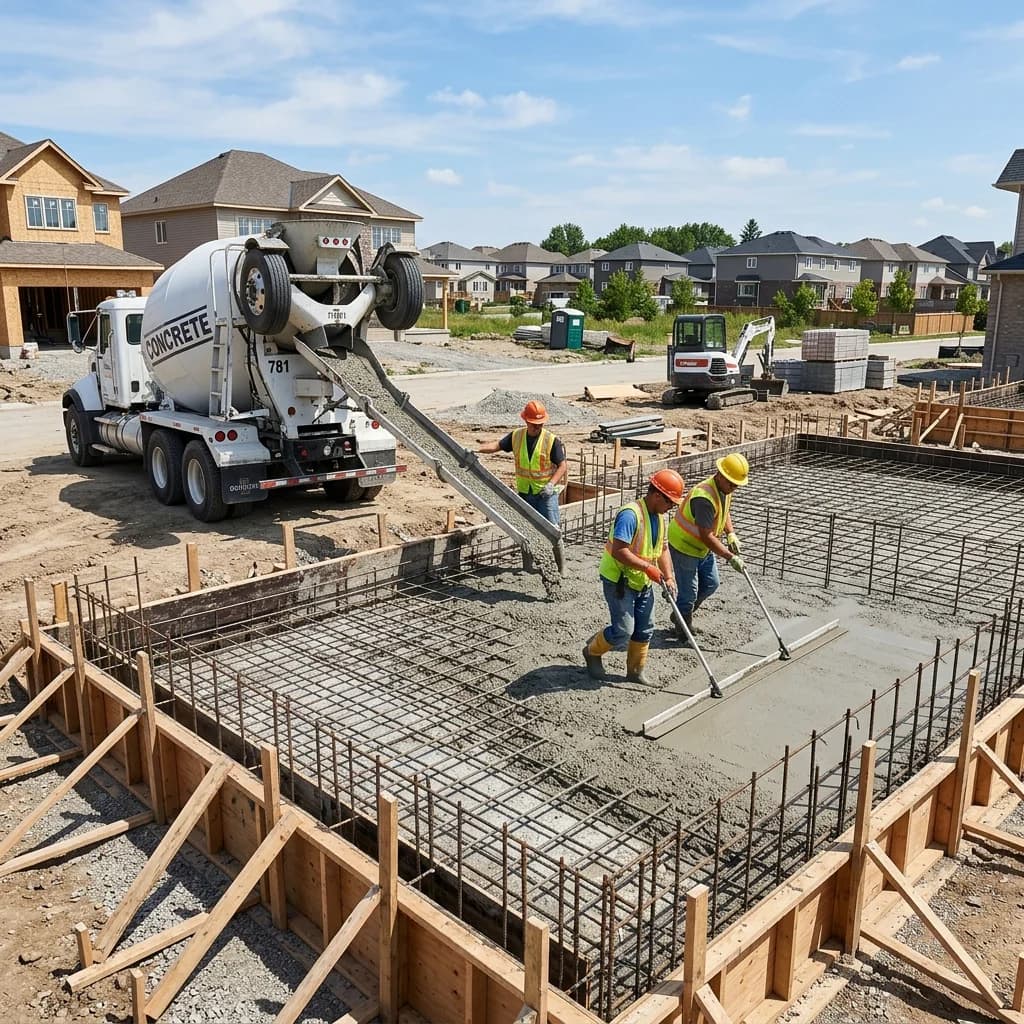
Concrete is one of the largest material costs in any new construction project. Whether you are pouring a slab foundation, footings, a driveway, or a patio, you need to know exactly how many cubic yards to order. Over-ordering is expensive, and under-ordering means paying for an additional delivery and dealing with cold joints.
The Concrete Volume Formula
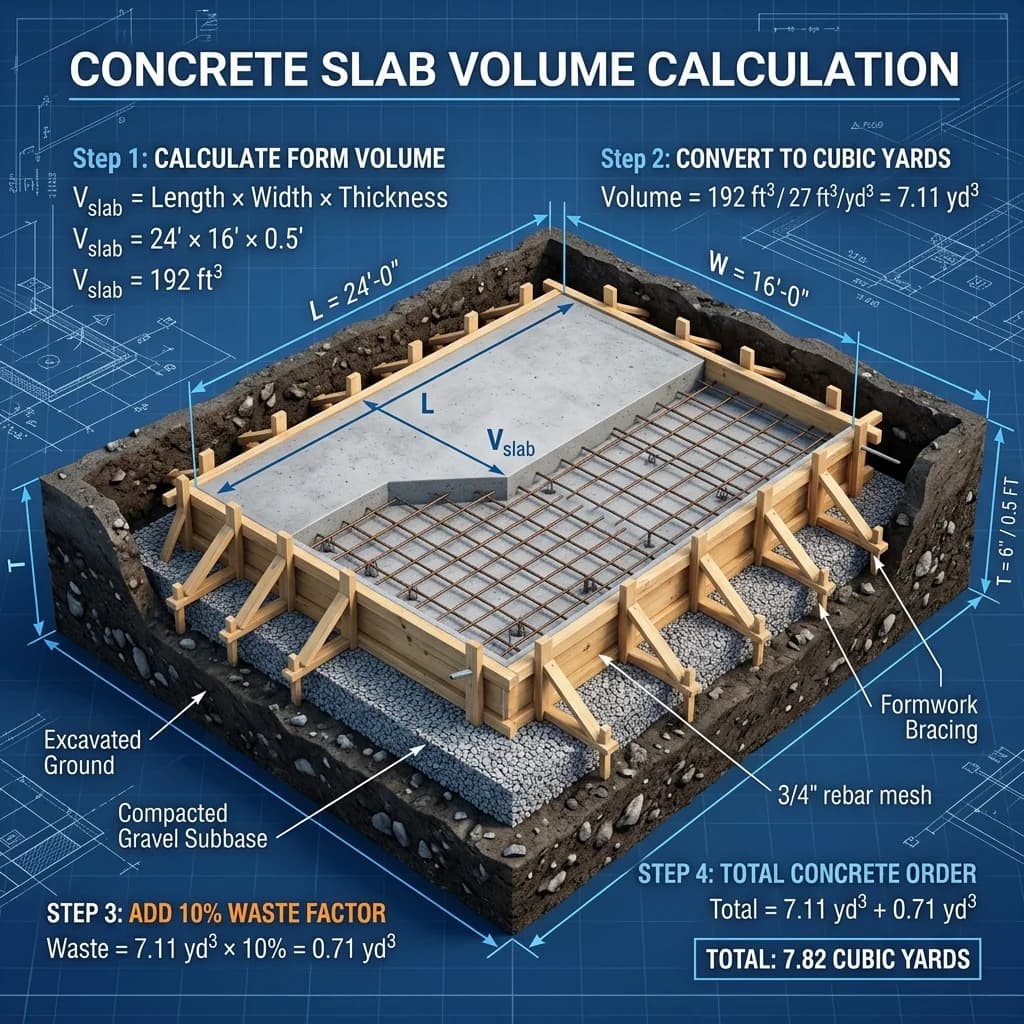
A concrete yardage calculator uses a simple volume formula. For a rectangular slab or footing, the calculation is:
Concrete Volume Formula
You divide by 27 because there are 27 cubic feet in one cubic yard. Always convert thickness from inches to feet first by dividing by 12.
Example: A 30 ft × 50 ft slab that is 4 inches thick: Thickness = 4 / 12 = 0.333 ft. Volume = 30 × 50 × 0.333 / 27 = 18.52 cubic yards.
Accounting for Waste and Over-Excavation
The formula above gives you the net volume, but you should always order 5% to 10% more than the calculated amount. Uneven subgrade, forms that bow under pressure, and spillage all increase the actual volume needed. For a detailed walkthrough of a concrete slab calculation, check out our guide on How Much Concrete for a 20×20 Slab.
Use our Concrete Slab Calculator to get an instant yardage estimate for your specific dimensions, or our Foundation Calculator for footings and wall foundations. If you are mixing your own concrete, understanding the right proportions is critical—read our guide on How to Read a Concrete Mix Ratio (1:2:3 Explained).
Reinforcement: Steel Rebar
Concrete is strong in compression but weak in tension. Steel rebar reinforcement is essential for foundations, footings, and elevated slabs. The amount and spacing of rebar depends on the structural loads and local building codes. Use our Steel Rebar Calculator to estimate rebar quantities, and read our detailed guide on How to Calculate Rebar for Footings.
5. House Framing Material Takeoffs: Lumber, Sheathing, and Hardware
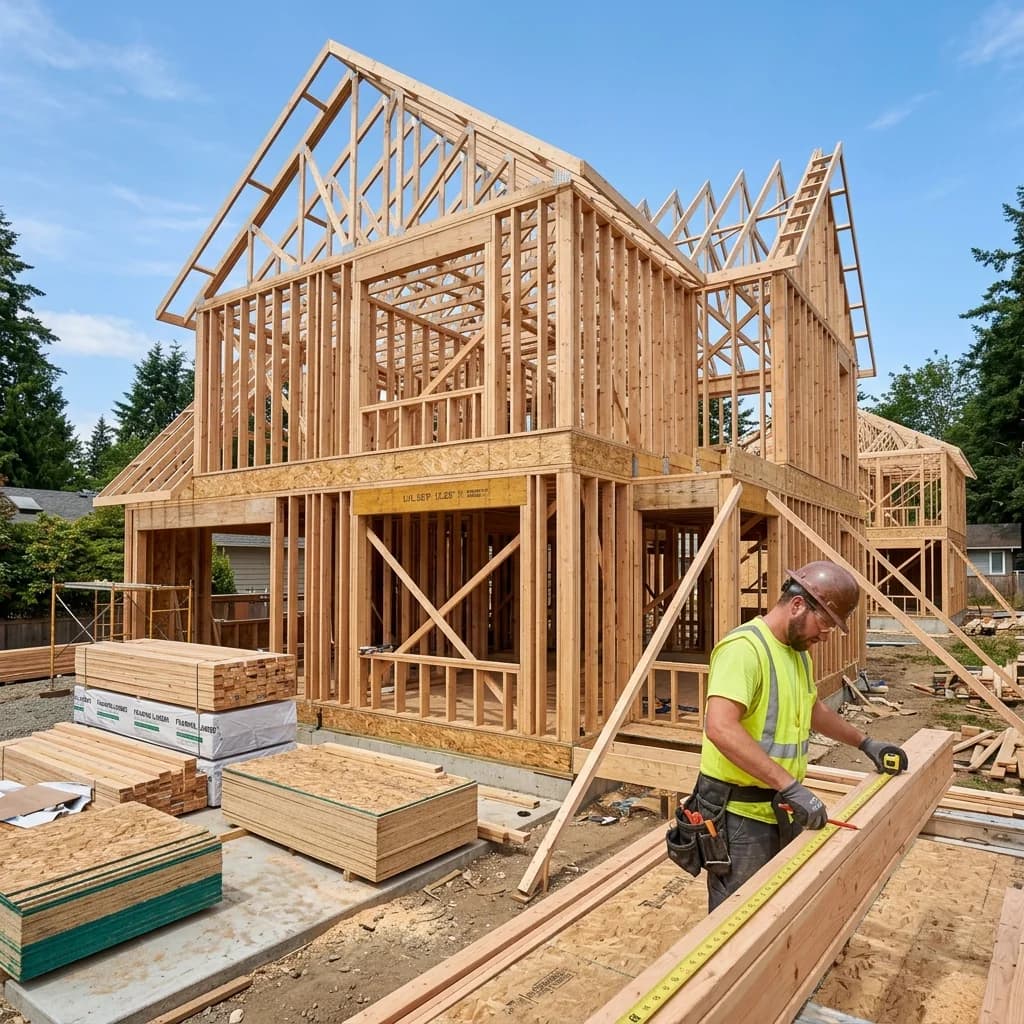
House framing material takeoffs are the detailed lists of every piece of lumber, sheet of plywood, and box of fasteners needed to frame a building. A thorough takeoff prevents costly mid-project orders and keeps the framing crew working efficiently without downtime.
What Goes Into a Framing Takeoff?
A complete framing takeoff includes the following categories:
- Wall Studs: Exterior and interior walls are framed with vertical studs, usually 2×4 or 2×6 lumber, spaced 16 inches on center. A standard 8-foot wall uses pre-cut 92-5/8 inch studs with a double top plate and single bottom plate.
- Floor Joists: These horizontal members support the floor above. Common sizes include 2×8, 2×10, and 2×12, depending on the span and load. Engineered products like I-joists or LVL beams are used for longer spans.
- Roof Rafters or Trusses: The roof structure can be stick-built with individual rafters or assembled from pre-manufactured trusses. Trusses are faster and more cost-effective for most residential projects.
- Sheathing: Plywood or OSB (Oriented Strand Board) sheets are nailed to the exterior walls and roof deck. Standard 4×8 sheets are used, and you calculate the quantity based on the total wall and roof surface area.
- Headers and Beams: Every window and door opening requires a header to carry the load above. Headers are typically built from doubled 2×10 or 2×12 lumber, or engineered LVL beams for wider spans.
- Fasteners and Hardware: Nails, screws, joist hangers, hurricane ties, and hold-down brackets. These small items add up quickly and should not be overlooked.
Use our Lumber & Wood Calculator to estimate your framing package. For a wall-by-wall floor plan takeoff workflow, see Floor Plan to Lumber List. It is critical to understand the difference between nominal and actual lumber dimensions when planning your takeoff—review our guide on Nominal vs. Actual Lumber Sizes.
Quick Framing Estimate Rule of Thumb
As a rough industry benchmark, a typical wood-framed house requires approximately 6.3 board feet of lumber per square foot of living area. This means a 2,000-square-foot home would need roughly 12,600 board feet of lumber for the frame alone. However, this is only a starting estimate. The actual quantity depends on wall height, number of stories, window and door openings, and complexity of the roof design.
Waste Factor for Framing Lumber
Always add 10% to 15% to your framing lumber order to account for cutting waste, defective boards, and on-site damage. Lumber is a natural product and some boards will arrive with splits, warps, or excessive knots that make them unusable. Read more in our guide on Lumber Waste Factors.
6. Estimating Interior Materials: Drywall, Paint, and Finishes
Once the framing is complete, the interior finishing phase begins. This phase represents a significant portion of your total budget and includes drywall installation, painting, flooring, and trim work.
- Drywall: Standard 4×8-foot drywall sheets are used to cover interior walls and ceilings. You calculate the number of sheets by dividing the total wall and ceiling area by 32 (the area of one sheet). Our guide on Estimating Drywall, Joint Compound, and Tape covers the entire process. Use our Drywall Calculator for quick estimates.
- Paint: One gallon of interior paint typically covers 350 to 400 square feet with one coat. Most rooms require two coats, so plan accordingly. Our Paint Coverage Calculator makes this estimate easy. For a step-by-step approach, see How to Estimate Paint for Interior Walls.
- Flooring: Whether you choose hardwood, tile, or carpet, the cost is calculated per square foot. Tile installations require additional materials like mortar, grout, and spacers. Our Tile Flooring Calculator estimates all of these components together.
7. Labor Cost Estimation: The Largest Variable
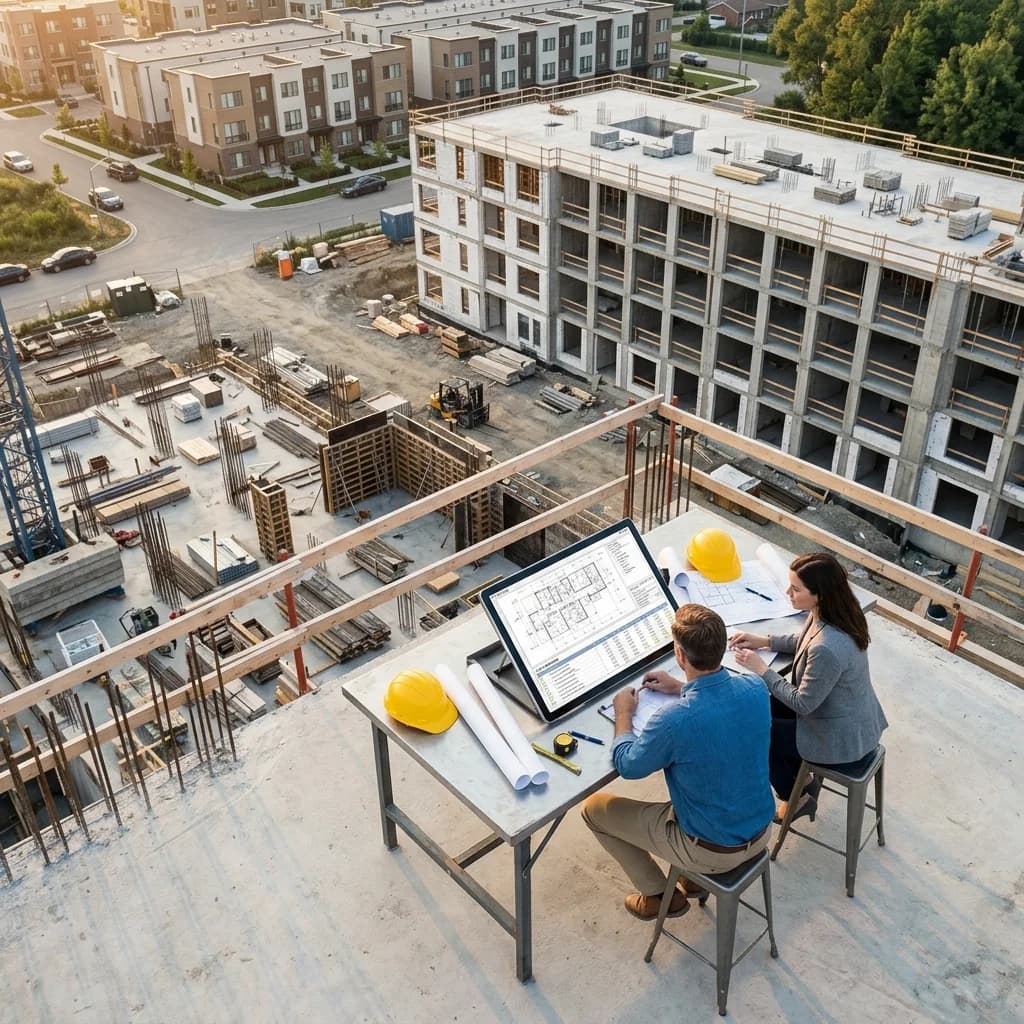
Labor is the single largest variable in any construction budget. It depends on your geographic location, the complexity of the project, the availability of skilled workers, and the current demand in the construction market. Getting labor estimates right is just as important as getting material quantities right.
How Labor Costs Are Calculated
Construction labor is typically estimated using one of two methods:
- Per Square Foot: Many general contractors quote labor as a flat rate per square foot. For a standard residential home, labor rates range from $50 to $100 per square foot, depending on the region and project complexity.
- Hourly Rate by Trade: A more detailed approach is to estimate labor hours per phase and multiply by the hourly rate for each trade. For example, a framing carpenter might charge $25 to $45 per hour, while an electrician charges $50 to $100 per hour. Our Labor Cost Estimator helps you build a detailed labor budget by trade.
Typical Labor Cost Breakdown by Phase
| Construction Phase | % of Total Labor Budget | Typical Hourly Rate Range |
|---|---|---|
| Foundation & Concrete | 10% – 15% | $20 – $40/hr |
| Framing | 15% – 20% | $25 – $45/hr |
| Plumbing | 10% – 15% | $45 – $85/hr |
| Electrical | 10% – 15% | $50 – $100/hr |
| HVAC | 5% – 10% | $40 – $75/hr |
| Drywall & Interior Finish | 15% – 20% | $20 – $40/hr |
| Roofing | 5% – 10% | $25 – $50/hr |
| Painting & Trim | 5% – 10% | $20 – $40/hr |
8. Construction Loan Planning: Financing Your Build
Unless you are paying for your entire project in cash, you will need a construction loan to fund the build. Understanding how construction financing works is essential to managing your cash flow and keeping the project moving forward.
How a Construction Loan Works
A construction loan calculator is different from a standard mortgage calculator because construction loans are not disbursed in a single lump sum. Instead, the lender releases funds in stages called draws. Each draw corresponds to a completed phase of construction (foundation, framing, roof, etc.), and the lender typically sends an inspector to verify the work before releasing the next payment.
During the construction phase, you make interest-only payments on the amount that has been drawn, not on the full loan amount. Once construction is complete, the loan either converts to a standard mortgage or must be refinanced.
Residential vs. Commercial Construction Loans
A residential construction loan calculator typically models a 12- to 18-month construction period with interest-only payments, followed by conversion to a 15- or 30-year fixed-rate mortgage. A commercial construction loan calculator handles larger loan amounts, longer construction timelines (often 18 to 36 months), and more complex draw schedules with stricter lender oversight.
For commercial builds, loan amounts are larger and draw schedules are more complex, but the same budgeting principles apply. Use our Construction Cost Calculator to build the line-item budget lenders expect, and read our guide on The 10% Construction Waste Factor when setting your contingency reserve.
What Lenders Look For in Your Construction Budget
Lenders scrutinize your construction budget carefully. They want to see:
- Detailed Line-Item Budget: A breakdown of every cost category (site work, foundation, framing, MEP, finishes, etc.) with specific dollar amounts. Our Construction Cost Calculator generates this kind of detailed breakdown.
- Realistic Contingency: A 10% to 15% contingency reserve shows the lender you are prepared for surprises.
- Licensed Contractor Agreement: Most lenders require you to hire a licensed general contractor. Owner-builder loans exist but carry stricter requirements.
- Appraisal of Completed Value: The lender will order an appraisal of the expected completed value of the property. The loan amount is typically limited to 80% to 90% of this value (Loan-to-Value ratio).
Pro Tip: Avoid These Common Estimation Mistakes
Even experienced builders make calculation errors that cost thousands of dollars. The most common mistakes include forgetting to convert units, miscalculating area, and failing to account for material waste. Read our guide on Top 5 Common Construction Math Mistakes to avoid these costly pitfalls.
9. Putting It All Together: A Complete Estimation Workflow
Here is a step-by-step workflow you can follow to create a complete construction cost estimate from scratch:
- Step 1 — Define the Scope: Determine the total square footage, number of stories, foundation type, and level of finish. Sketch the basic layout or work from architectural drawings. If you need help interpreting blueprints, see our guide on Reading Blueprints for Accurate Site Measurements.
- Step 2 — Estimate the Foundation: Use the Foundation Calculator and Concrete Slab Calculator to determine concrete yardage and rebar quantities.
- Step 3 — Complete the Framing Takeoff: Use the Lumber & Wood Calculator to estimate studs, joists, rafters, and sheathing. Add 10% to 15% for waste.
- Step 4 — Estimate Exterior and Interior Materials: Calculate roofing, siding, drywall, paint, tile, and insulation using our specialized calculators.
- Step 5 — Build a Labor Budget: Estimate labor hours per phase and apply the trade-specific rates using our Labor Cost Estimator.
- Step 6 — Add Soft Costs: Include permit fees, architectural and engineering fees, surveys, inspections, utility connections, and insurance.
- Step 7 — Apply Contingency: Add 10% to 15% to the total budget for unforeseen expenses.
- Step 8 — Secure Financing: Take your completed budget to your lender and model your loan payments with a construction loan calculator.
10. Sample Cost Breakdown for a 2,000 Sq Ft Home
To give you a concrete reference point, here is an approximate cost breakdown for a 2,000-square-foot single-family home built to a mid-range quality standard in a moderate-cost region:
| Cost Category | Estimated Cost | % of Total |
|---|---|---|
| Site Work & Excavation | $15,000 – $25,000 | 5% – 7% |
| Foundation & Concrete | $25,000 – $40,000 | 8% – 12% |
| Framing (Lumber & Labor) | $40,000 – $65,000 | 13% – 20% |
| Roofing | $10,000 – $18,000 | 3% – 6% |
| Plumbing | $15,000 – $25,000 | 5% – 8% |
| Electrical | $12,000 – $22,000 | 4% – 7% |
| HVAC | $10,000 – $18,000 | 3% – 6% |
| Drywall & Interior Finish | $25,000 – $40,000 | 8% – 12% |
| Flooring | $10,000 – $20,000 | 3% – 6% |
| Windows & Exterior Doors | $8,000 – $15,000 | 3% – 5% |
| Cabinets & Countertops | $10,000 – $25,000 | 3% – 8% |
| Siding & Exterior Finish | $12,000 – $20,000 | 4% – 6% |
| Permits, Fees & Soft Costs | $8,000 – $15,000 | 3% – 5% |
| Contingency (10%) | $20,000 – $35,000 | 10% |
| Estimated Total | $220,000 – $383,000 | 100% |
These ranges reflect the national average for mid-range construction. Your actual costs will vary based on location, material selections, and market conditions. For a customized estimate, enter your specific project details into our Construction Cost Calculator.
Frequently Asked Questions
How accurate is a cost to build a house calculator?
A well-designed cost to build a house calculator provides estimates that are typically within 10% to 20% of the actual final cost when you input accurate project specifications. The accuracy improves significantly when you use specialized calculators for individual cost categories (concrete, lumber, labor) rather than relying on a single per-square-foot number. Always include a 10% to 15% contingency buffer to account for variables that no calculator can predict, such as weather delays and unexpected site conditions.
What is the difference between a construction loan and a traditional mortgage?
A construction loan is a short-term loan (typically 12 to 18 months) that funds the building process. It disburses funds in stages called draws as construction progresses, and you pay interest only on the amount drawn. A traditional mortgage is a long-term loan (15 or 30 years) used to purchase an existing home. After construction is complete, a construction loan either converts to a standard mortgage (in a construction-to-permanent loan) or must be refinanced separately.
How many cubic yards of concrete do I need for a typical house foundation?
A typical slab-on-grade foundation for a 1,500-square-foot home with a 4-inch thick slab requires approximately 18 to 20 cubic yards of concrete. If the foundation also includes perimeter footings (usually 12 inches wide by 12 inches deep), you may need an additional 5 to 8 cubic yards. Always add 5% to 10% extra to your calculated volume to account for waste, uneven subgrade, and spillage. Use our Concrete Slab Calculator for a precise estimate based on your exact dimensions.
What percentage of a construction budget goes to labor?
Labor typically accounts for 40% to 50% of the total budget for residential construction and 50% to 60% for commercial projects. The exact percentage depends on your region, the complexity of the design, and the current demand for skilled tradespeople. In high-cost metropolitan areas with strong labor unions, labor costs can be significantly higher than the national average. Use our Labor Cost Estimator to build a phase-by-phase labor budget for your specific project.
References
Standards and data referenced in this guide. Building codes are adopted locally, so verify requirements with your jurisdiction before you build.
- Concrete design and construction standards — American Concrete Institute
- Span tables and the National Design Specification for Wood Construction — American Wood Council
About the Author

Hassan Baloch — An experienced Civil Engineer with more than a decade in building and structural planning. Hassan rigorously verifies the mathematical formulas and code compliance of our estimation tools to guarantee absolute precision. Contact our team for technical inquiries.
Related Guides
The 10% Rule: Why Construction Waste Factors Can Make or Break Your Budget
Learn why ordering the exact amount of material often leads to project failure and how to correctly calculate the construction waste factor for concrete, lumber, and more.

How to Read a Concrete Mix Ratio (1:2:3 Explained)
Master the standard 1:2:3 concrete mix ratio for your next DIY or professional project. Learn exactly what these numbers mean, how to measure materials, and when to adjust your mix.
How Much Concrete for a 20x20 Slab?
Planning a new garage or patio? Learn exactly how to calculate the cubic yards and bag counts for a 20x20 concrete slab, including waste factors and professional tips.
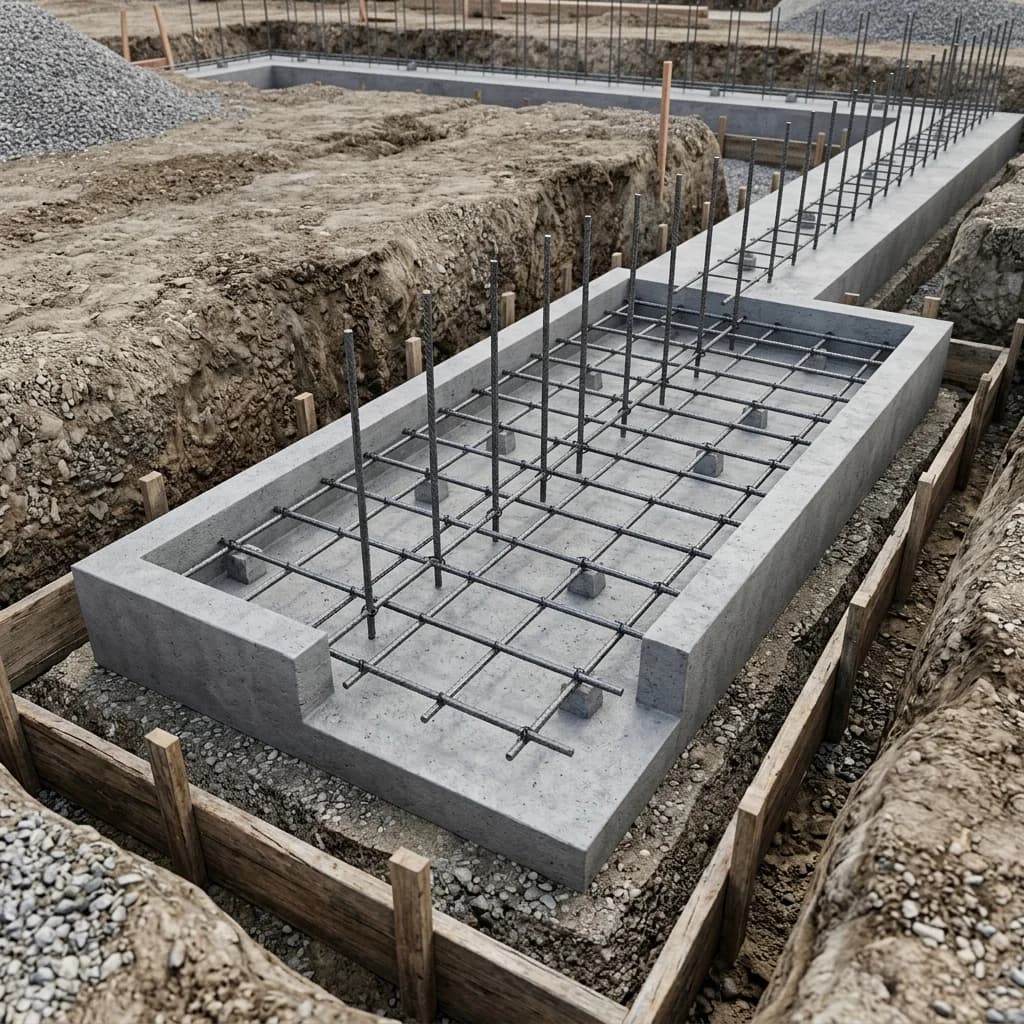
Foundation Footing Size Guide for Residential Homes
Understand how to determine the correct size of foundation footing for a residential home. Learn how soil bearing capacity, building load, and frost line depth dictate structural footing dimensions.