
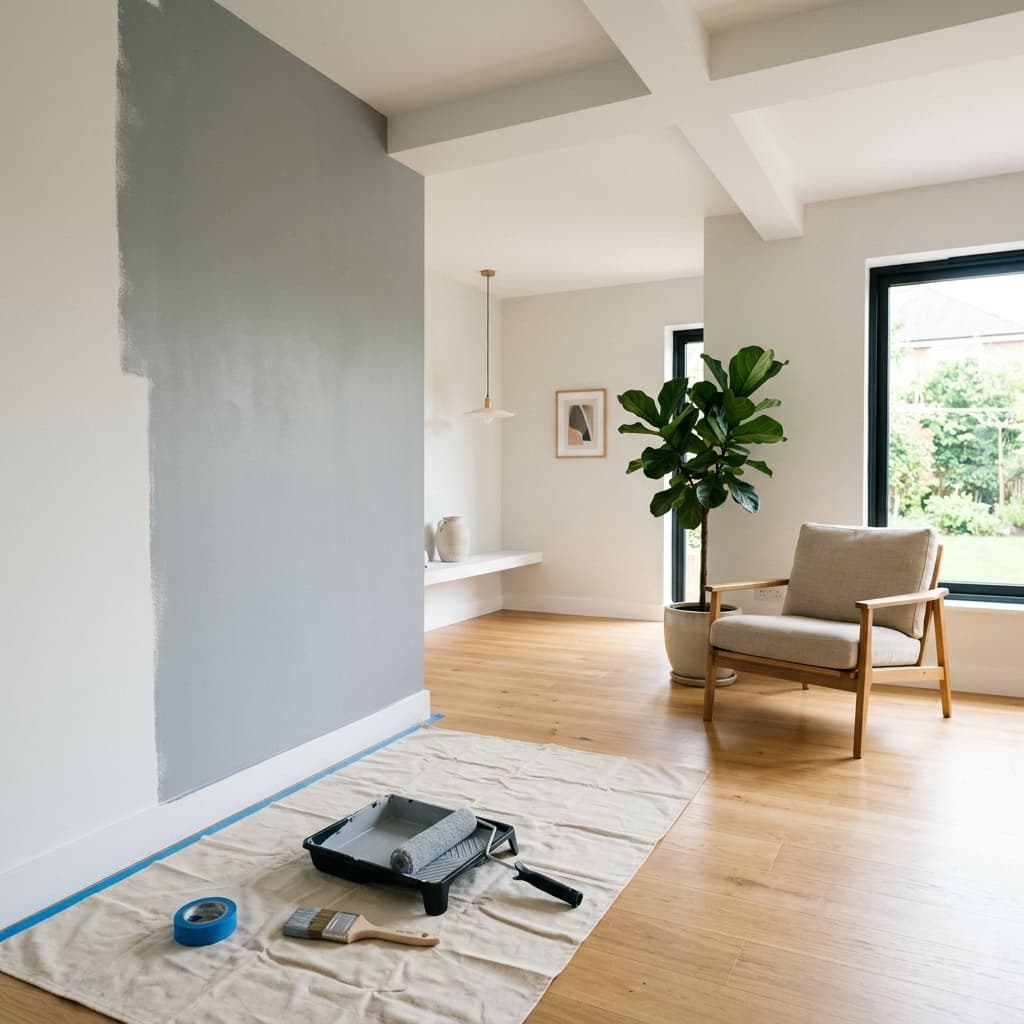
How to Estimate Paint for Interior Walls
Learn how to accurately calculate the amount of paint you need for your interior walls. This guide covers measuring, surface area calculations, and using a paint calculator to save time and money.
Whether you are refreshing a single room or painting your entire home, one of the most common questions is: "How much paint do I need?"
Estimating paint correctly is the difference between a smooth weekend project and making three frustrated trips to the hardware store. If you buy too little, you risk a "color mismatch" if the new batch isn't mixed perfectly. If you buy too much, you're left with expensive cans of paint gathering dust in your garage.
In this guide, we will walk you through the simple steps to measure your space, calculate your square footage, and use a professional paint calculator to get your order exactly right.
1. Measure Your Walls
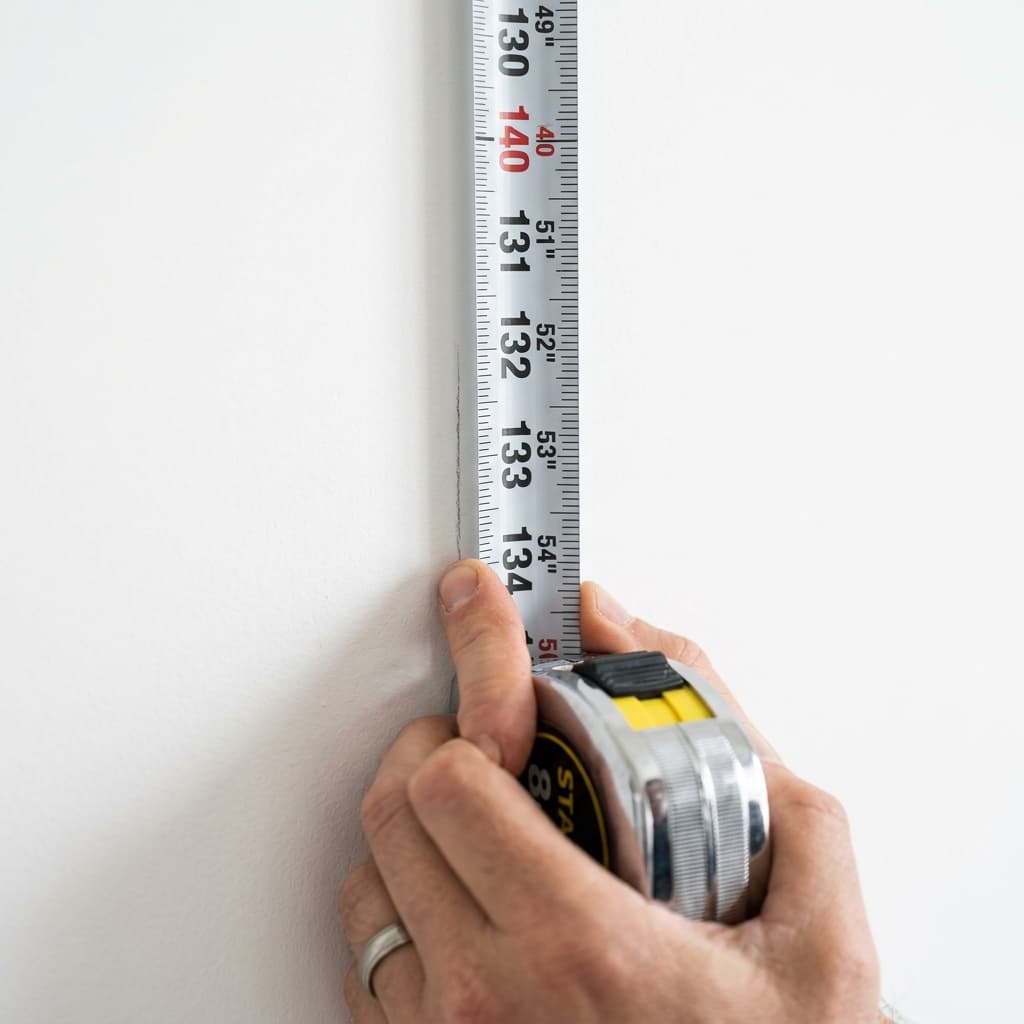
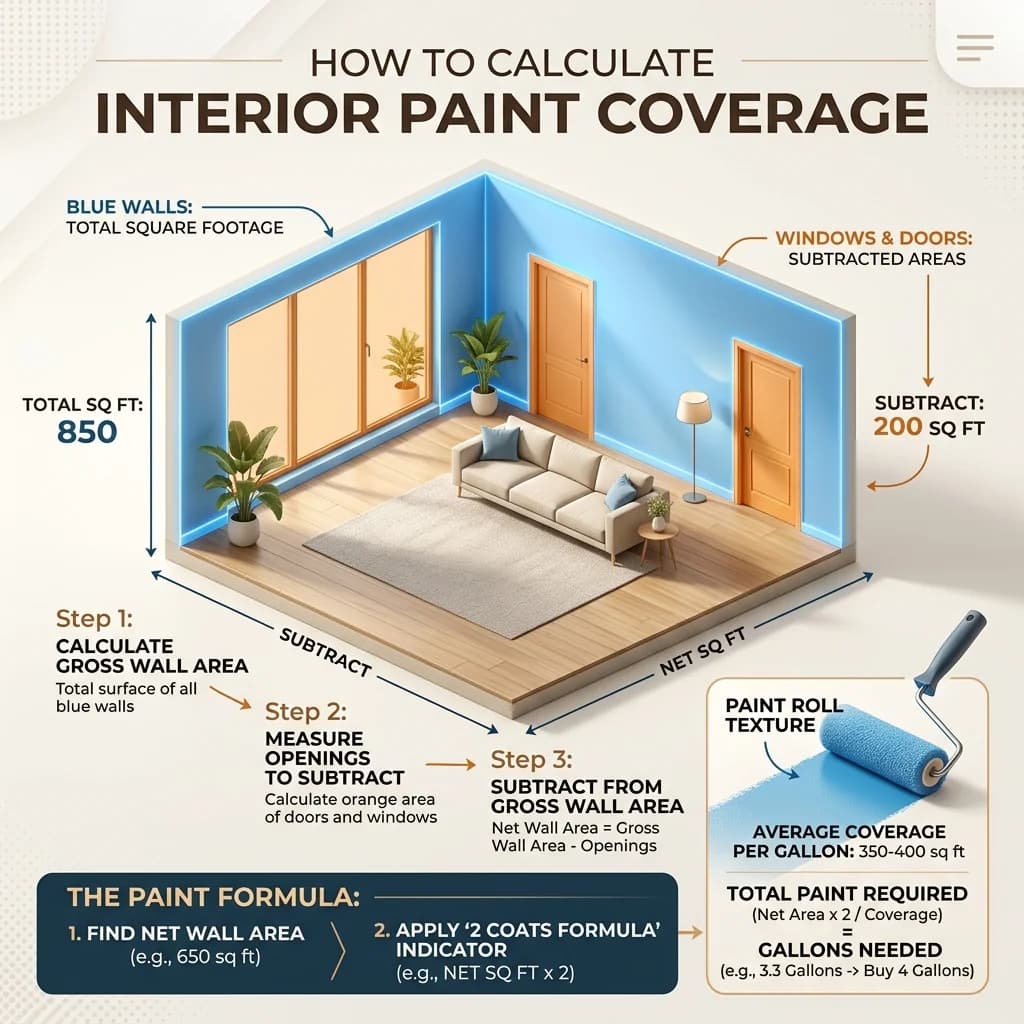
The first step is to find the total surface area of the walls you plan to paint. Grab a tape measure and record the height and width of every wall in the room.
To calculate the area of a single wall, simply multiply the width by the height. For example, if a wall is 12 feet wide and 8 feet high, the area is 96 square feet (12 x 8 = 96). Repeat this for every wall and add the totals together.
Pro Tip: Don't forget the ceiling! If you plan to paint the ceiling the same color, measure the length and width of the floor and multiply them to find the ceiling's square footage.
2. Subtract Doors and Windows
You don't want to buy paint for areas you aren't actually painting. To get a more accurate estimate, subtract the area of doors and windows from your total wall area.
- Standard Door: Typically about 21 square feet.
- Standard Window: Typically about 15 square feet.
Subtract these from your total. For example, if your total room area is 400 square feet but you have two windows and one door, your "net" painting area is about 349 square feet (400 - 15 - 15 - 21 = 349).
3. The "400 Square Foot" Rule
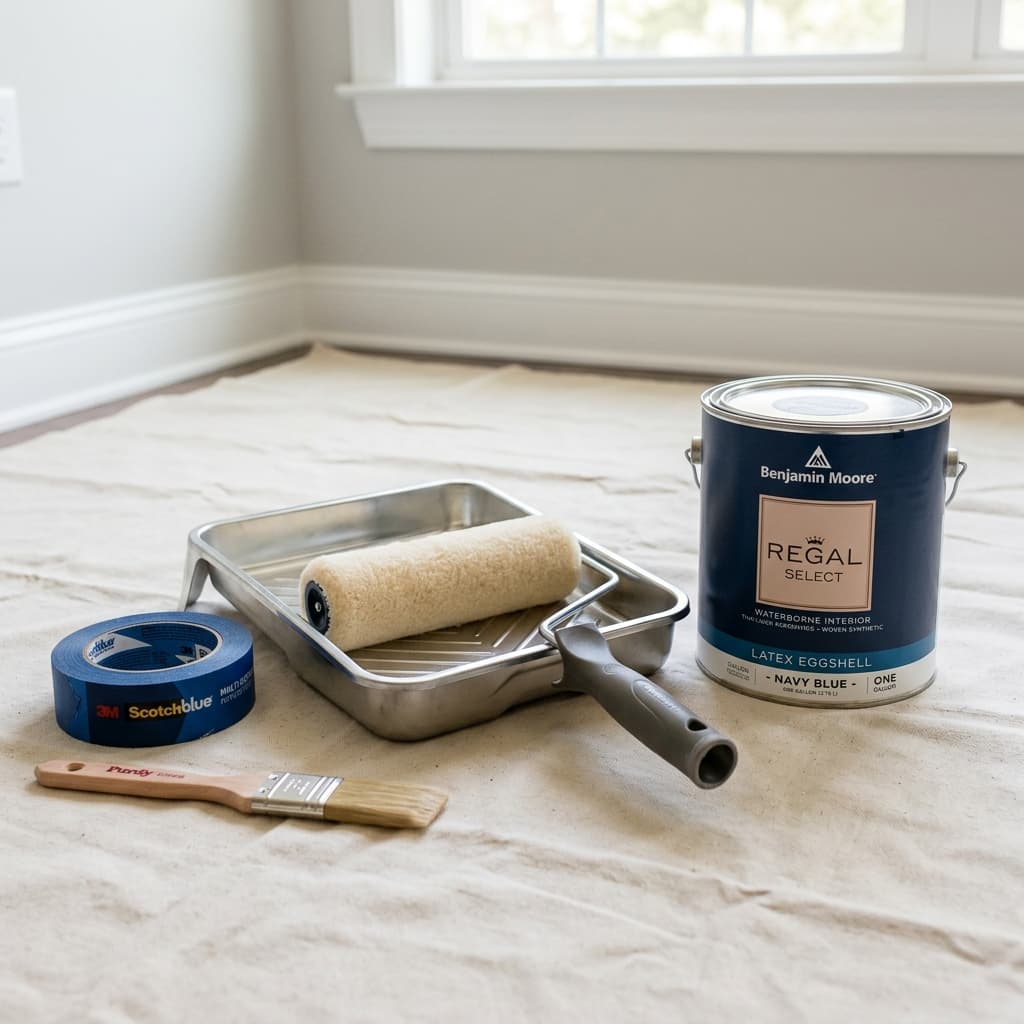
As a general rule of thumb used by professional painters, one gallon of quality interior paint covers approximately 400 square feet with a single coat.
However, most projects require two coats for a professional, streak-free finish. This means you should double your total square footage before dividing by 400.
If your net area is 349 square feet, you will need to cover 698 square feet (349 x 2). Dividing 698 by 400 gives you 1.745 gallons. Since you can't usually buy partial gallons, you would order 2 gallons.
Paint Quantity Formula
Where G is gallons needed, Atotal is the net surface area, and n is the number of coats.
4. Factors That Change Everything
While the 400 sq. ft. rule is a great starting point, several factors can affect how much paint your walls will "drink":
- Wall Texture: Rough or textured walls (like popcorn ceilings or heavy stucco) have more surface area than flat walls and require up to 20% more paint.
- Porous Surfaces: New, unpainted drywall is very thirsty. Always use a primer first, or you'll find yourself needing many more coats of expensive finish paint.
- Color Changes: Painting a light color over a dark wall often requires a high-hide primer and potentially three coats of paint to prevent the old color from "bleeding" through.
5. Using the Wall Paint Tool
Manually calculating all these variables can be tedious. That's why we created the Wall Paint Tool.
Our calculator allows you to input your wall dimensions, subtract openings, and even account for waste factors instantly. It takes the guesswork out of your project, ensuring you buy exactly what you need—no more, no less.
Coverage rates worth knowing
The 400 square foot figure assumes smooth, previously painted, sealed drywall. Most surfaces are not that, and the gap between the label claim and what you actually get is where people run out mid-wall.
| Surface | Square feet per gallon | Notes |
|---|---|---|
| Smooth, previously painted drywall | 350–400 | The best case the label assumes |
| Light texture / orange peel | 300–350 | More real surface than it looks |
| Knockdown or heavy texture | 250–300 | Back-rolling uses more again |
| Bare drywall with PVA primer | 200–300 | Paper and compound absorb differently |
| Masonry, stucco, block | 150–200 | Budget roughly double a flat wall |
Priming bare drywall is not an optional extra step that costs you a gallon. It saves you money, because primer is cheaper than finish paint and stops the wall drinking two coats of the expensive stuff before it starts to look even.
A full worked room
A 12 by 14 foot bedroom with 9 foot ceilings, one door and two windows.
The perimeter is 2 × (12 + 14) = 52 feet, so gross wall area is 52 × 9 = 468 square feet. Subtract the door at 21 and two windows at 15 each, and the net is 417 square feet. Two coats means covering 834 square feet, and at a realistic 375 per gallon that is 2.2 gallons — so 3 gallons for the walls.
The ceiling is a separate calculation and a separate product: 12 × 14 = 168 square feet, doubled for two coats is 336, which is 1 gallon of ceiling paint. Trim is separate again, in semi-gloss, and a quart usually does a room this size unless you have deep baseboards.
Note what happened there. A single room needs three different products, and the person who calculates one number and buys three gallons of wall paint ends up rolling wall paint onto the ceiling.
Two buying notes. If you need three or more gallons of one colour, price the 5 gallon bucket — it is often cheaper than the gallons individually and guarantees a single batch. And whenever a colour spans more than one container, pour them all into a larger bucket and stir before you start, a practice painters call boxing. Tinted paint varies very slightly between batches, and boxing means that variation is spread invisibly across the whole room instead of appearing as a hard line where you opened the second can.
Final Checklist Before You Buy
- Double-check your measurements: It's better to measure twice and buy once.
- Always buy a little extra: Keep a small quart of your specific color for future touch-ups.
- Don't forget the trim: If you are painting baseboards and door frames, use our Lumber Calculator to find linear footage and estimate a separate gallon of semi-gloss trim paint.
Ready to start your transformation? Head over to our Paint Calculator and get your professional estimate in seconds!
About the Author

Hassan Baloch — An experienced Civil Engineer with more than a decade in building and structural planning. Hassan rigorously verifies the mathematical formulas and code compliance of our estimation tools to guarantee absolute precision. Contact our team for technical inquiries.
Related Calculators
Paint Coverage Calculator
Calculate gallons of paint needed for interior/exterior walls.
Paint Cost Calculator
Estimate total spend for interior and exterior painting.
Area & Perimeter Calculator
Calculate area and perimeter for various shapes.