Floor Plan to Lumber List: How to Estimate Framing and Building Materials
Turn a residential floor plan into a wall-by-wall framing lumber takeoff. Learn to read plan sheets, count studs and sheathing, build a lumber order, and avoid the mistakes that cause mid-job shortages.
A floor plan shows where walls go — but it does not ship with a lumber list. Before your framer can order studs, plates, and sheathing, someone has to translate every wall line, opening, and floor bay on that drawing into counts and lengths. That translation is a framing takeoff, and it is one of the most practical skills you can learn from a set of plans.
This guide is about that translation only: reading a floor plan, building a wall-by-wall lumber worksheet, and producing an order list your supplier can quote. It does not replace a full construction budget — for pricing, labor, concrete, loan planning, and phase-by-phase costs, use our separate guide on The True Cost of Building. Here we stay focused on the lumber estimator calculator workflow: dimensions in, piece counts out.
For quick math, use our Lumber & Wood Calculator alongside a hand takeoff. If you have never pulled dimensions from a drawing before, start with Reading Blueprints for Accurate Measurements.
What a Floor Plan Does — and Does Not — Tell You
The floor plan (often sheet A1.1 in a plan set) is a top-down view at a specific cut height — usually 4 feet above the finished floor. It shows:
- Exterior wall outlines and overall building dimensions
- Interior partition locations and room labels
- Door swings and rough opening tags (linked to a door/window schedule)
- Stair openings, fireplace chases, and mechanical shafts
- Wall type notes (2×4 vs 2×6, bearing vs non-bearing)
It does not show ceiling heights, roof pitch, rafter sizes, or header depths — those live on elevation sheets, sections, and the roof plan. A complete framing takeoff pulls from multiple sheets. If you only have the floor plan, note missing data as "TBD from elevations" rather than guessing.
Step 1: Set Up Your Takeoff Worksheet
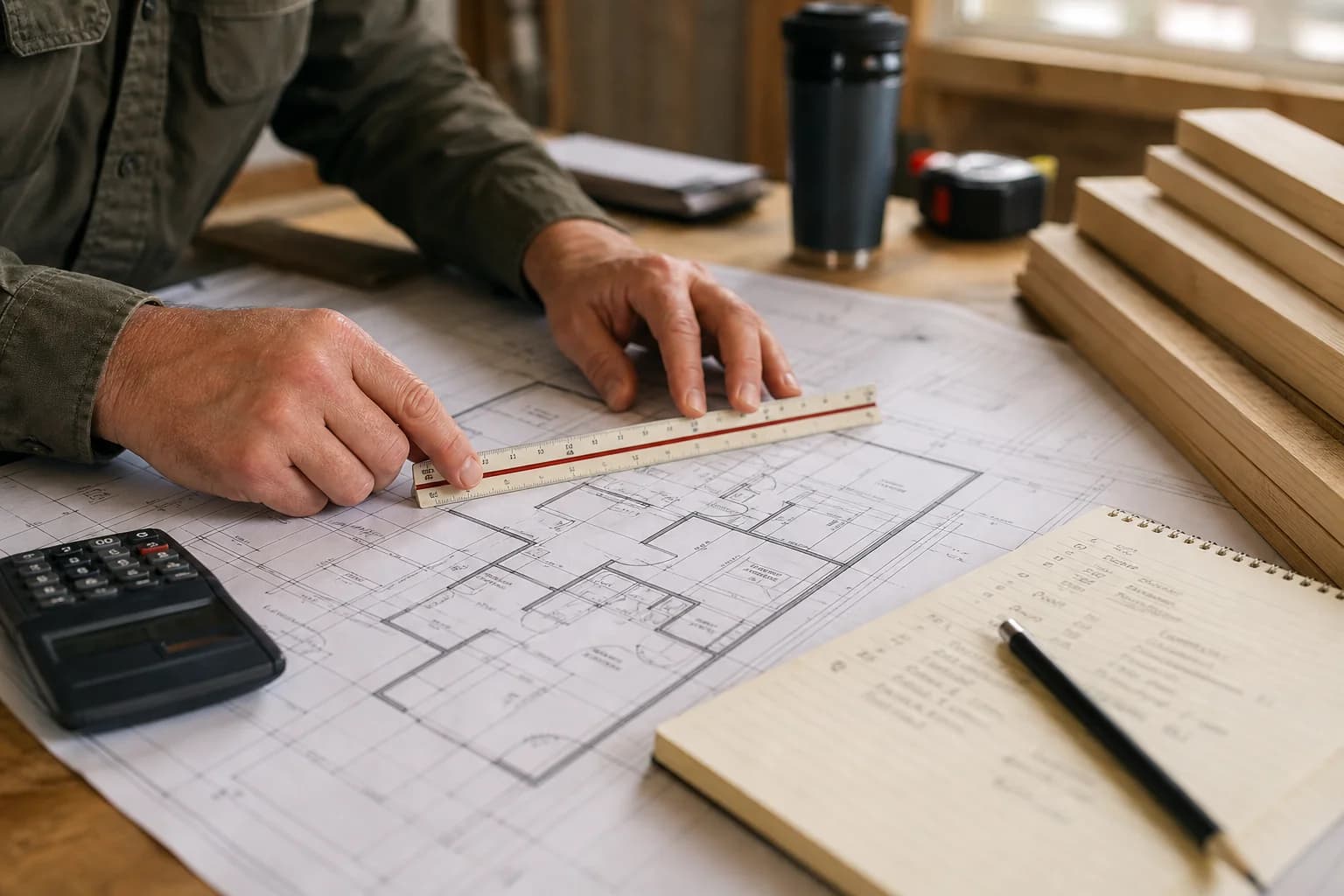
Professional estimators work wall by wall, not room by room. Create a spreadsheet with one row per wall segment. Label each wall (North exterior, Kitchen south partition, etc.) so you can trace a number back to the plan.
| Wall ID | Length (ft) | Stud size | Spacing | Stud count | Plate LF | Notes |
|---|---|---|---|---|---|---|
| Ext-N1 | 32 | 2×6 | 16" OC | 26 + openings | 96 | 2 windows, 1 entry door |
| Int-K1 | 14 | 2×4 | 16" OC | 12 | 42 | Non-bearing partition |
Measure each wall length on the plan using the stated scale (common: 1/4" = 1'-0"). Cross-check against written dimension strings — if your scaled measurement and the callout disagree by more than an inch, use the written dimension and flag the drawing for clarification. Our Area & Perimeter Calculator helps verify odd-shaped wings and L-shaped footprints.
Step 2: Count Studs, Plates, and Opening Framing
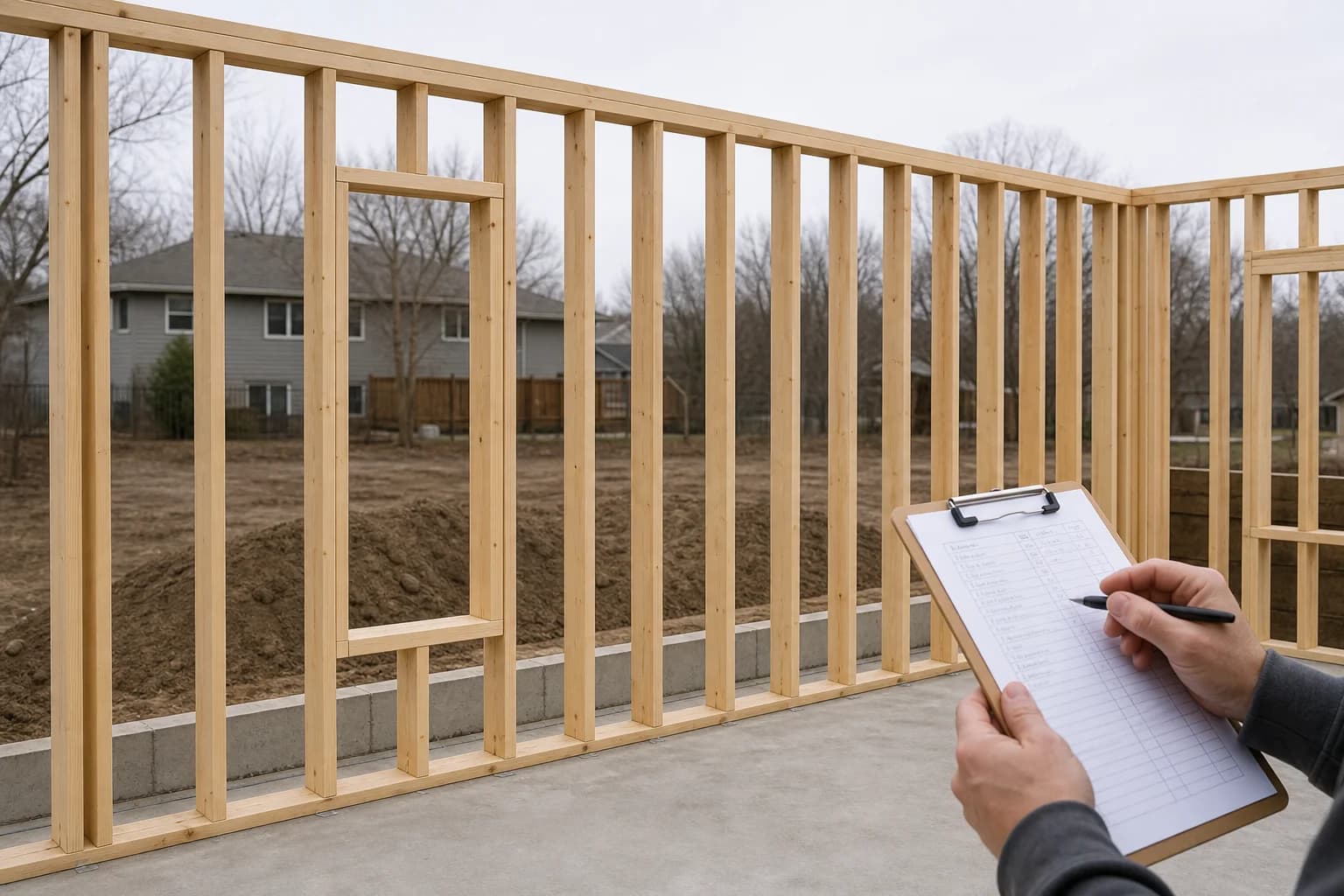
Regular stud spacing
For walls without openings, studs at 16 inches on center follow this count:
Base Stud Count per Wall
Where L is wall length in feet and 1.333 ft equals 16-inch spacing. The +1 accounts for the stud at each end. Round up always — you cannot order half a stud.
Door and window openings
Each rough opening on the floor plan adds lumber beyond the regular spacing count. From the door/window schedule, note the rough opening width and height, then add:
- 2 king studs — full height, one at each side of the opening
- 2 jack studs — cut to header bearing height, support the header
- 1 header — usually doubled 2×10 or 2×12 (check structural notes for span tables)
- Cripples — short studs above the header and below the sill (windows only)
A standard 3'-0" × 6'-8" interior door in an 8-foot wall typically adds about 8 to 12 pieces of lumber beyond what spacing alone would count. Track openings separately in your worksheet "Notes" column so you do not double-count.
Plates
Every wall gets one bottom plate and a double top plate. Plate linear feet for one wall equals three times the wall length. Sum all walls for total plate lumber — then buy in standard lengths (8, 10, 12, 16 feet) and note cut waste.
Exterior walls marked 2×6 on the plan use 2×6 studs and plates throughout that wall line. Interior partitions are usually 2×4 unless the plan marks them as plumbing walls (often 2×6 for pipe clearance). Mixed sizes mean separate subtotals on your order form.
Step 3: Sheathing and Subfloor from Plan Dimensions
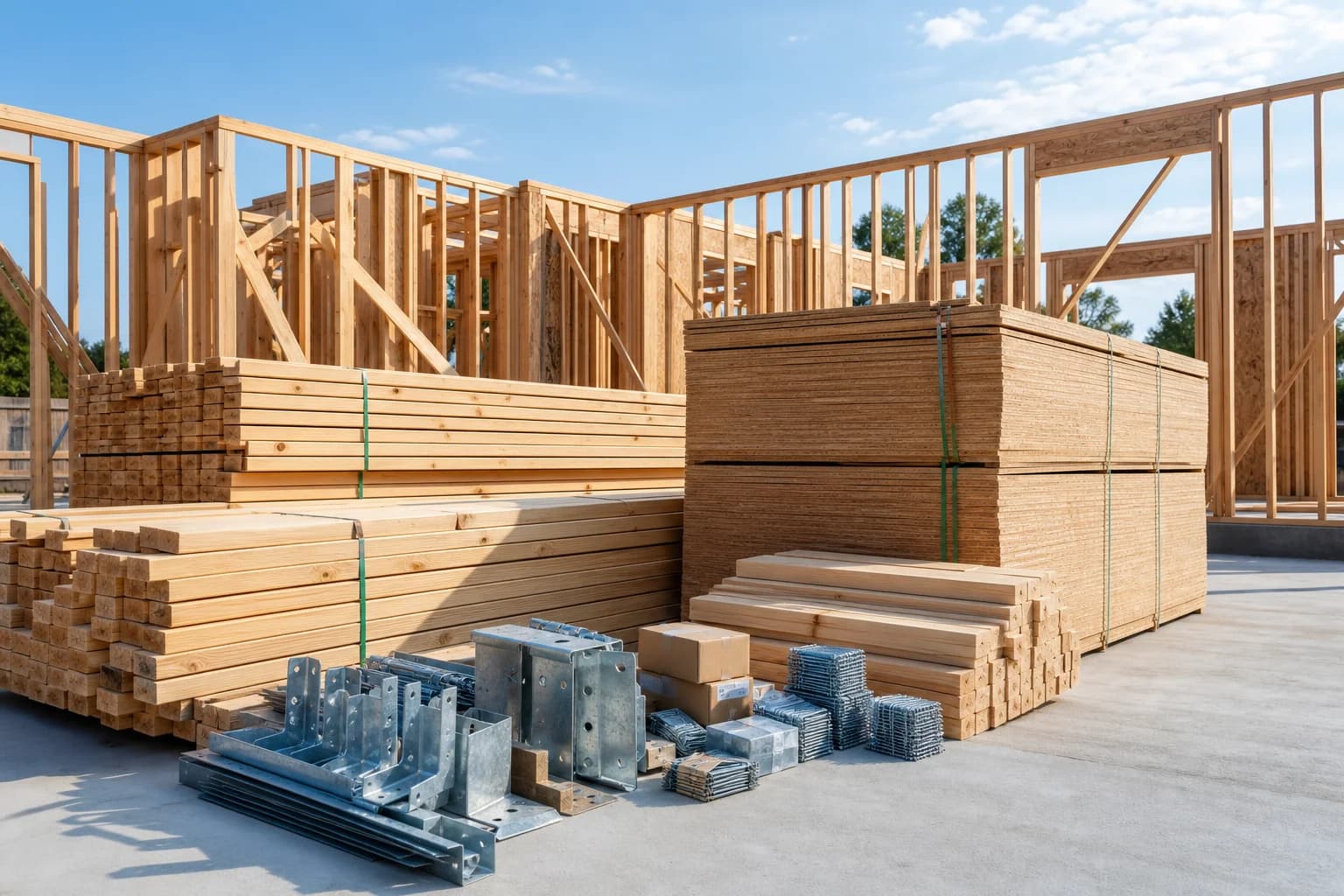
Sheathing is measured in 4×8 sheets (32 sq ft each). From the floor plan you can calculate:
- Wall sheathing: exterior wall length × wall height (from elevations) ÷ 32
- Subfloor: each floor's enclosed area ÷ 32 — use room dimensions from the plan
- Roof deck: needs the roof plan, not the floor plan — do not guess from footprint alone if overhangs or dormers exist
Deduct only large continuous openings (garage door bays) from sheathing area — not every window. Window cutouts become scrap used elsewhere; add 10% sheet waste instead. Use Wall Square Footage Calculator to total exterior wall surface once you have heights from elevations.
Step 4: Stick Frame vs. Trusses — Read the Roof Plan
The floor plan alone cannot tell you whether the roof is stick-framed or trussed. Check the roof plan sheet or general notes:
- Engineered trusses: the truss manufacturer produces a sealed lumber list — your takeoff covers wall framing, subfloor, and sheathing only; add truss delivery as a separate line item
- Stick framing: you must take off rafters, ridge board, ceiling joists, and collar ties from the roof plan and elevations — use our Roof Pitch Calculator for rafter length and roof area
Vaulted ceilings, dormers, and hip roofs add lumber that a simple footprint takeoff will miss. If the roof plan is missing, request it before you finalize the order — guessing rafter counts is how framing packages come up short.
Step 5: Hardware, Fasteners, and the Items Plans Skip
Floor plans never list nails, hangers, or adhesive — but your order should. Typical framing-package add-ons derived from the same takeoff totals:
- 16d framing nails — roughly 5 lb per 1,000 board feet of lumber
- Joist hangers — one per joist end at beam or ledger connections
- Hurricane ties / rafter clips — count each rafter or truss seat on the top plate
- Construction adhesive for subfloor — one tube per 8 to 10 sheets of decking
- House wrap and tape — exterior wall sheathing area from Step 3
These are small dollar lines compared to lumber, but missing joist hangers stops the job the same way missing studs does.
Step 6: Format a Lumber Order Your Supplier Can Quote
Lumberyards prefer orders grouped by material type and length — not by wall ID. Convert your worksheet into a summary like this:
| Item | Size | Length | Qty |
|---|---|---|---|
| Studs | 2×4 | 92-5/8" | 340 |
| Studs | 2×6 | 92-5/8" | 180 |
| Plates | 2×4 | 16' | 45 |
| Headers | 2×12 | 14' | 18 |
| Sheathing | 7/16" OSB | 4×8 | 210 sheets |
Add 10% to 15% to stud and plate quantities before submitting — see Lumber Waste Factors. Confirm whether prices are per piece or per thousand board feet. Understand nominal vs. actual lumber sizes so your count matches what arrives on the truck.
Run final totals through our Lumber Estimator Calculator to cross-check board feet against your piece count.
Step 7: Pull Finish Material Dimensions from the Same Plan
Once wall lengths and room areas are verified on your worksheet, you can pass those dimensions to downstream takeoffs without re-measuring the plan:
- Drywall & paint — wall and ceiling square footage from room dimensions; see Drywall Estimation Guide
- Flooring & tile — room length × width per space on the plan
- Insulation — exterior wall lineal feet × height from elevations
This guide stops at the framing package. Converting quantities into dollar budgets, labor hours, and loan draw schedules is covered in The True Cost of Building.
Takeoff Mistakes That Only Show Up on the Job Site
- Measuring centerline instead of face of wall — exterior dimensions are usually to the outside of framing; interior walls may be to centerline
- Mixing up plan north with sheet orientation — confirm the dimension strings match the wall you labeled "North"
- Forgetting fire-rated assemblies — garage-to-house walls may require 5/8" drywall on both sides, changing stud spacing or sheathing type
- Ignoring plan revisions — a Rev C floor plan can move walls; always take off the latest sheet
- Ordering from square footage alone — two plans with the same area can differ by thousands of board feet in roof complexity
Before You Order
Walk the worksheet with your framer or lumberyard counter staff. They catch local habits — like stocking 9-foot studs for 8-foot ceilings in your market — that generic takeoffs miss.
Floor Plan Takeoff Checklist
- Gather floor plan, elevations, roof plan, and door/window schedule
- Verify scale and written dimensions match
- Build wall-by-wall worksheet with stud size and spacing
- Add opening framing for every door and window tag
- Sum plates, headers, and sheathing sheets
- Confirm stick frame vs. truss package on roof plan
- Add hardware and fastener lines
- Apply 10% to 15% waste; convert to supplier order format
- Cross-check with Lumber Calculator
Frequently Asked Questions
What plan sheets do I need besides the floor plan for a lumber takeoff?
At minimum you need the floor plan, elevations (for wall heights), the roof plan (for rafters or truss layout), and the door/window schedule (for rough opening sizes). Foundation and section sheets help confirm bearing walls and header sizes. A floor plan alone is enough to start a wall worksheet but not enough to finalize the full package.
How do I count studs around a door opening on a floor plan?
Run the regular 16-inch-on-center count along the full wall length, then add king studs (2), jack studs (2), a doubled header, and any cripple studs above or below the opening. Do not subtract the opening width from wall length before counting — the framing fills that gap with larger members, not fewer studs.
Should I stick-frame the roof or order trusses?
Most production homes use engineered trusses because the manufacturer supplies a sealed lumber list and faster installation. Stick framing suits complex ceilings, dormers, or remote sites where truss delivery is costly. The roof plan and structural notes specify which approach the design assumes — follow the plan rather than switching mid-takeoff.
How should I format a lumber list for my supplier?
Group by item type, nominal size, and length — not by room. List stud counts by size and length (e.g., 340 pcs 2×4 × 92-5/8), plate stock by longest efficient length, headers by cut length, and sheathing by sheet count. Include waste factor in the quantities you submit, and note whether the yard prices per piece or per thousand board feet.
What waste factor should I add to a floor plan lumber takeoff?
Add 10% to 15% to studs, plates, and cut lumber on a typical rectangular home. Use 15% or higher when the plan has many gables, bay windows, or irregular angles that produce short cut-offs. Sheathing usually needs 10% extra sheets. Lumber arrives with defects, so some boards will not be usable even with perfect planning.
References
Standards and data referenced in this guide. Building codes are adopted locally, so verify requirements with your jurisdiction before you build.
- Span tables and the National Design Specification for Wood Construction — American Wood Council
- Engineered wood panel span ratings and sheathing guidance — APA – The Engineered Wood Association
- IRC 2021, Chapter 6 — Wall Construction (stud spacing, §R602) — International Code Council
About the Author

Zain Sheikh — With over 10 years of hands‑on experience in residential and commercial construction, Zain ensures that every calculator on our platform accounts for real‑world variables, waste factors, and site conditions. Contact our team for technical inquiries.
Related Guides
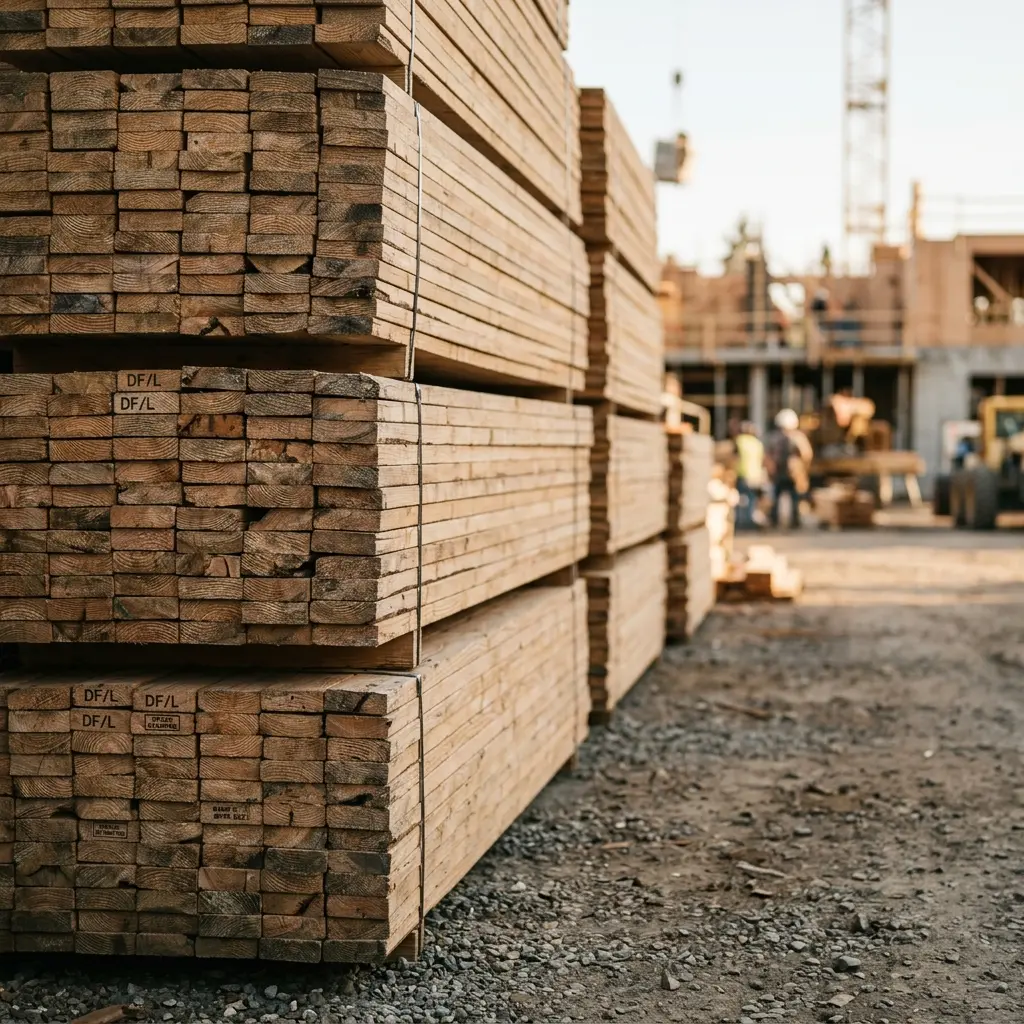
The Difference Between Nominal vs. Actual Lumber
Confused why a 2x4 doesn't measure 2x4? Learn the difference between nominal and actual lumber sizes, see our lumber size chart, and calculate your project needs accurately.

The True Cost of Building: How to Estimate Materials, Concrete, and Labor for New Construction
Learn how to accurately estimate construction costs for new builds. This complete guide covers material takeoffs, concrete yardage calculations, labor budgeting, framing estimates, and construction loan planning for residential and commercial projects.