
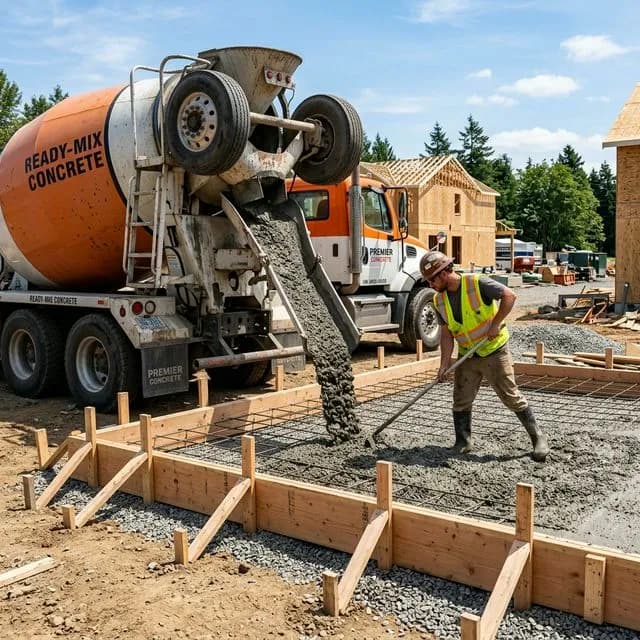
How Much Concrete for a 20x20 Slab?
Planning a new garage or patio? Learn exactly how to calculate the cubic yards and bag counts for a 20x20 concrete slab, including waste factors and professional tips.
A 20x20 slab is one of the most common dimensions in residential construction. Whether you are pouring a standard two-car garage, a spacious backyard patio, or a foundation for a small workshop, the "20x20" footprint is a versatile choice. However, the biggest question homeowners and DIYers face is: How much concrete do I actually need?
Ordering too little concrete leads to a "cold joint," which compromises structural integrity. Ordering too much is a waste of money and material. In this guide, we will break down the math, explain why thickness is the silent variable, and show you how to use a professional concrete slab calculator to get your order right the first time.
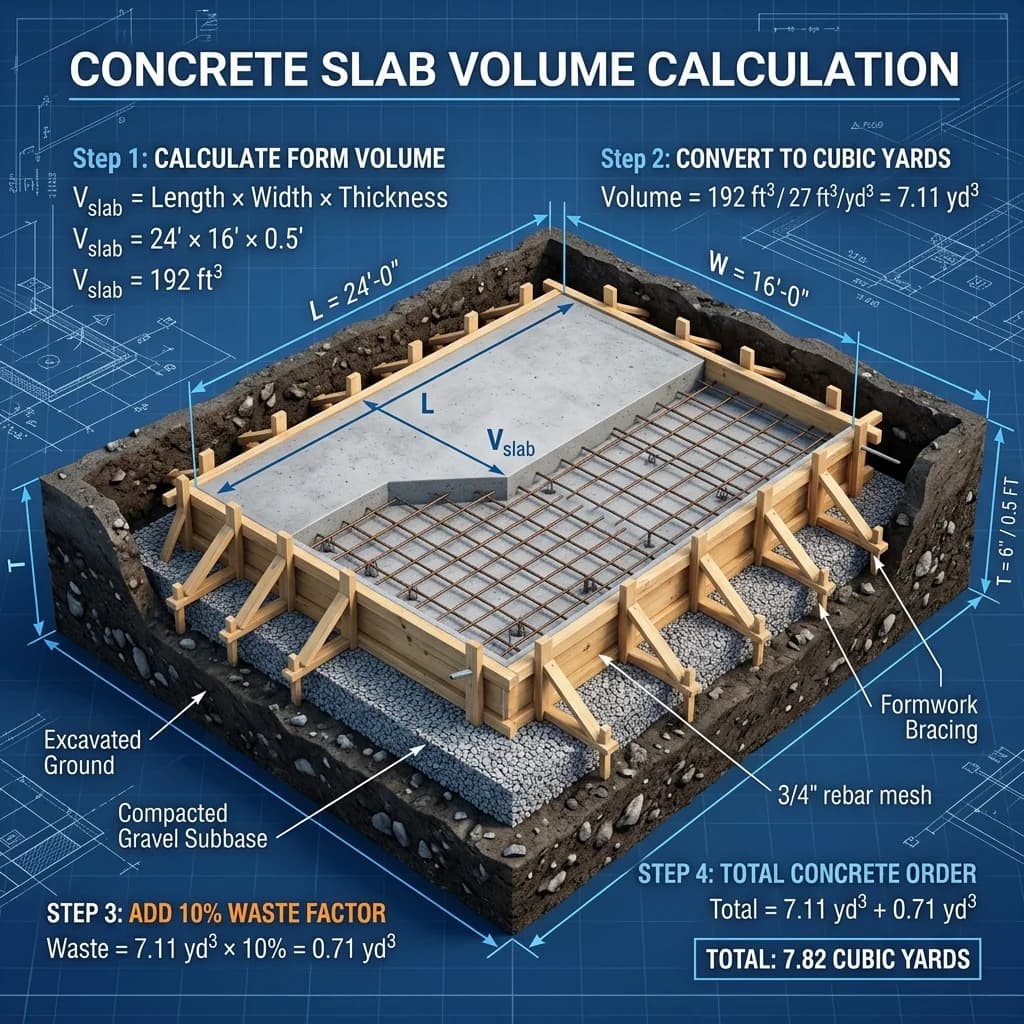
The Basic Math: Length x Width x Depth
To find the volume of any slab, you need three dimensions: the length, the width, and the thickness (depth). For a 20x20 slab, the length and width are fixed at 20 feet. The thickness, however, varies based on the intended use of the slab.
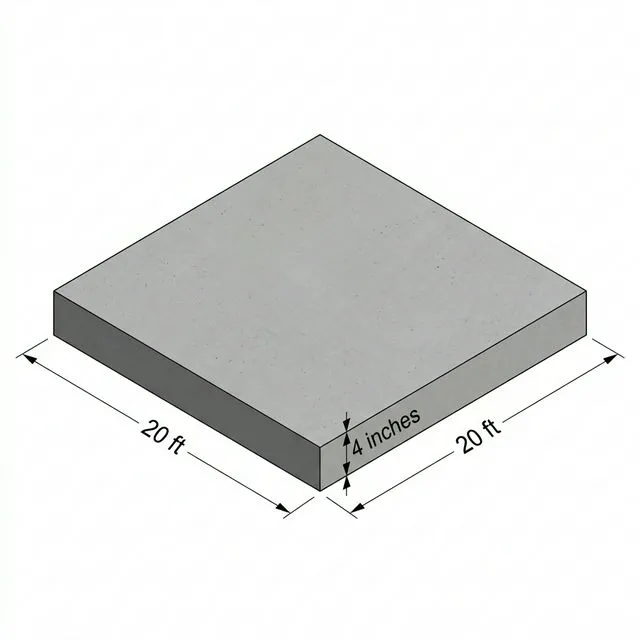
The standard thickness for residential slabs is typically:
- 4 Inches: Ideal for sidewalks, shed bases, and foot-traffic patios.
- 6 Inches: Required for driveways, heavy machinery floors, and structural foundations.
Calculating Volume in Cubic Yards
Concrete is almost always sold by the Cubic Yard. To convert your measurements, you must first calculate the volume in cubic feet and then divide by 27 (since there are 27 cubic feet in one cubic yard).
Concrete Volume Formula
Where L and W are in feet, and Dft is the thickness converted to feet (e.g., 4\" = 0.33 ft).
Example for a 20x20x4\" slab: (20 x 20 x 0.33) / 27 ≈ 4.94 Cubic Yards.
How Many Bags of Concrete for a 20x20 Slab?
If you are mixing the concrete yourself using bags, the numbers can be staggering. A 20x20 slab is quite large for bag-mixing, but for remote locations or small-crew projects, it is possible.
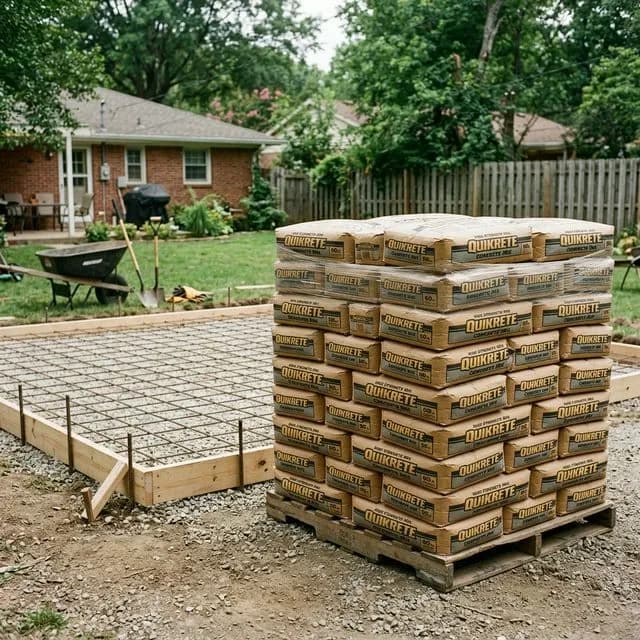
For a 20x20 slab at 4 inches thick (approx. 5 cubic yards):
- 80lb Bags: You will need approximately 225 bags.
- 60lb Bags: You will need approximately 300 bags.
This is why most professionals recommend ordering a ready-mix truck for any slab over 10x10. Mixing 225 bags by hand is an exhausting task that risks the concrete drying at different rates across the slab.
Don't Forget the 10% Waste Factor
In construction, nothing is perfectly flat. Your subgrade (the dirt or gravel base) might have slight dips, and your wooden forms might bulge slightly under the pressure of wet concrete.
Always add a 10% waste factor to your total. For our theoretical 4.94 cubic yard slab, you should order 5.5 cubic yards. Having half a yard left over is much better than being two wheelbarrows short at the end of a long day.
Ready-Mix vs. Bags: Which should you choose?
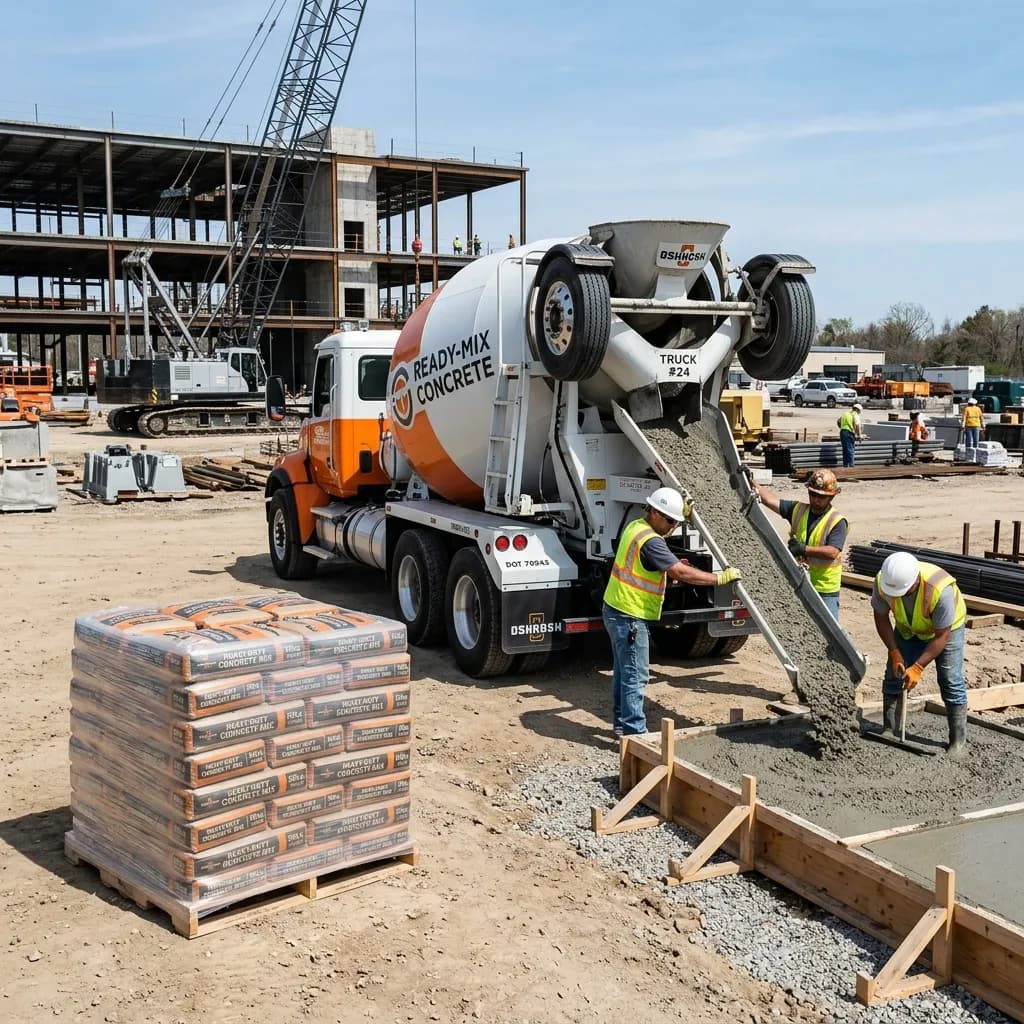
For a 20x20 slab, the choice is usually clear. A ready-mix truck provides a consistent, high-strength mix delivered and poured in minutes. While the truck might have a minimum \"short load\" fee if you order less than 5-7 yards, the labor savings for a 20x20 area are immense.
If you choose bags, ensure you have multiple mixers running and a large crew to keep a \"wet edge\" at all times.
How thickness changes the order
A 20x20 slab is 400 square feet, so the only variable driving your concrete volume is depth. Four inches is standard for patios and walkways, five is a sensible upgrade for a driveway, and six is what you want under vehicles heavier than a car or where the subgrade is questionable.
| Thickness | Net volume | Order with 10% waste | 80 lb bags equivalent |
|---|---|---|---|
| 4 inches | 4.94 cu yd | 5.5 cu yd | ~245 bags |
| 5 inches | 6.17 cu yd | 7.0 cu yd | ~305 bags |
| 6 inches | 7.41 cu yd | 8.25 cu yd | ~370 bags |
The bag column is there to settle the ready-mix argument rather than to recommend anything. An 80 pound bag of concrete mix yields about 0.6 cubic feet, so even the thinnest version of this slab is roughly 245 bags — around ten tons of material to haul, open, and mix while keeping a wet edge across 400 square feet. That is not a one-weekend job for a small crew, and the finish will show every batch you fell behind on. Bags make sense for post holes and small pads. At 20x20, order the truck.
Control joints: where and how deep
Concrete cracks as it cures. Control joints do not prevent that, they decide where it happens, by creating a deliberate weak line the crack follows out of sight.
Two rules govern the layout. Spacing in feet should be no more than two to three times the slab thickness in inches, which for a 4 inch slab means joints every 8 to 12 feet. And each panel should be roughly square, with the long side no more than about 1.5 times the short side — long thin panels crack across the middle regardless of what you do at the edges.
For 20x20 at 4 inches, one cut in each direction gives four 10 by 10 panels, which satisfies both rules comfortably. Cut the joints to a quarter of the slab depth, so one inch on a 4 inch slab. Anything shallower will not reliably control the crack. If you are tooling joints during the pour, do it as the bleed water leaves; if you are saw-cutting, get in within 6 to 18 hours of the pour, because waiting until the next day usually means the slab has already chosen its own crack line.
Pro Tips for a Perfect 20x20 Slab
- Subgrade Preparation: Use a plate compactor on your gravel base. A soft base leads to cracking.
- Reinforcement: Use rebar (1/2\" or #4) spaced 12-18 inches apart for any slab intended for vehicles.
- Control Joints: For a 20x20 slab, you must cut control joints. At minimum, divide the slab into four 10x10 sections to prevent random cracking.
Use Our Concrete Slab Calculator
Ready to get specific? Don't guess with a pencil and paper. Use our professional-grade concrete slab calculator to input your exact dimensions and get a precise material list, including bag counts and cubic yards.
By taking the time to calculate accurately, you ensure a smoother pour, a stronger slab, and a much more professional result. Happy building!
References
Standards and data referenced in this guide. Building codes are adopted locally, so verify requirements with your jurisdiction before you build.
- Concrete design and construction standards — American Concrete Institute
- Cement and concrete mix design references — Portland Cement Association
About the Author

Zain Sheikh — With over 10 years of hands‑on experience in residential and commercial construction, Zain ensures that every calculator on our platform accounts for real‑world variables, waste factors, and site conditions. Contact our team for technical inquiries.
Related Calculators
Concrete Slab Calculator
Volume and material calculations for flat slabs.
Concrete Mix Calculator
Calculate bags of concrete mix, cement, sand, and gravel.
Foundation Calculator
Estimate concrete required for footings and foundations.