
How to Calculate Rebar for Footings: A Complete Builder's Guide
Learn exactly how to calculate rebar for continuous and isolated footings. Master concrete cover, lap splices, and sizing with our complete professional guide.
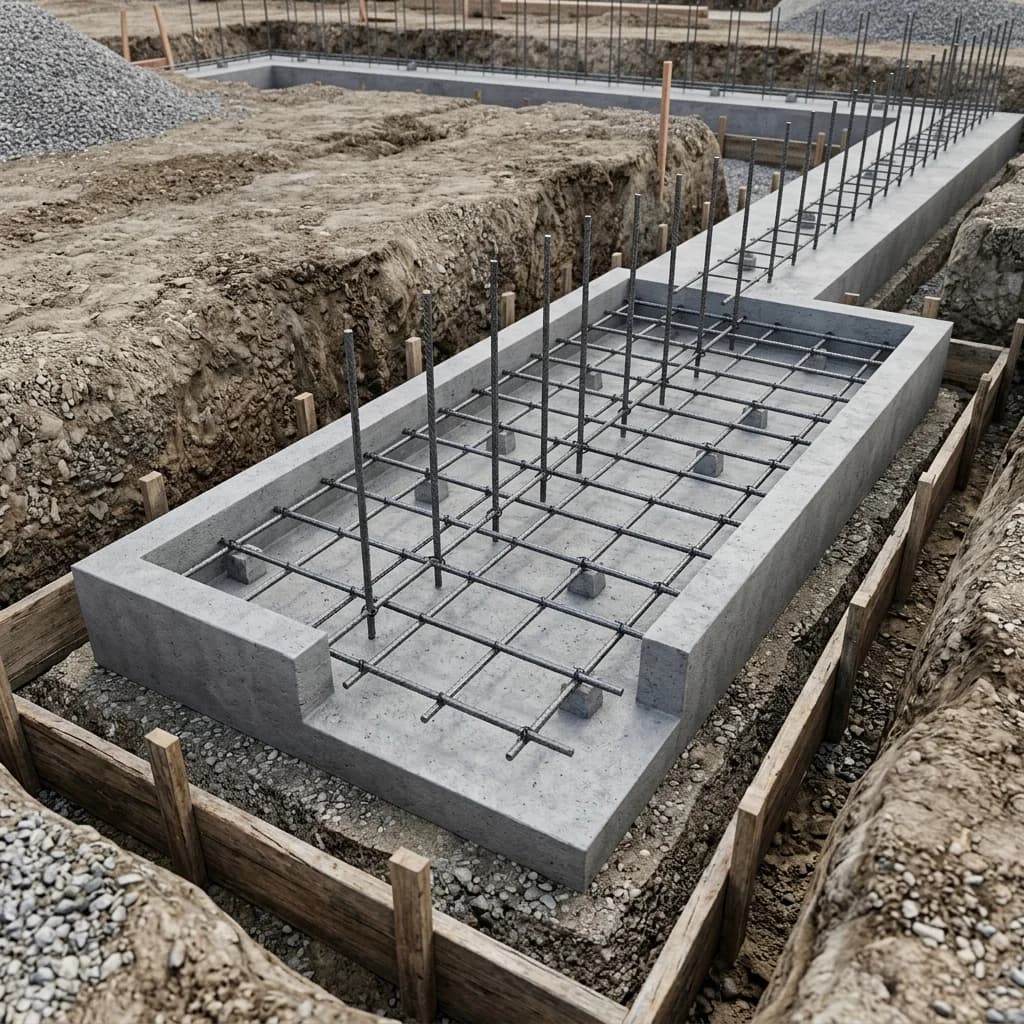
Every great construction project begins with a solid foundation. And at the absolute bottom of that foundation lie the concrete footings. Footings act as the feet of your building, spreading the immense weight of walls, roofs, and floors safely into the earth. But concrete alone is not enough to carry this load. To prevent shifting, settling, and catastrophic cracking, structural engineers embed steel reinforcing bars—better known as rebar—into the concrete.
Calculating the exact amount of rebar needed for a footing is one of the most critical steps in the estimating phase of a project. If you order too little, your project grinds to a halt while you wait for a secondary delivery. If you order too much, you waste hundreds of dollars on steel that will sit and rust in the dirt.
In this comprehensive guide, we will break down the exact mathematics of estimating steel reinforcement for both continuous and isolated pad footings. We will cover building codes, concrete cover clearance, lap splices, and how using a professional rebar length calculator can save you time and prevent expensive site errors.
Why Does Concrete Need Steel Rebar?
To understand why we calculate rebar the way we do, it is helpful to look at the physics of concrete. Concrete is a remarkable material with incredibly high compressive strength. This means it can support a massive amount of weight pushing down on it without crushing.
However, concrete has very poor tensile strength. When a force tries to bend, pull, or stretch concrete, it snaps easily. Soils naturally expand, contract, and settle unevenly over time. This movement puts the footing under tension.
Steel rebar has exceptionally high tensile strength. When we embed steel bars into wet concrete, they bond together as a composite team. The concrete handles the heavy crushing loads from above, while the steel handles the bending and pulling forces from the moving ground below.
The Three Core Rules of Footing Rebar
Before running any numbers, every builder must understand the three fundamental concepts that dictate structural rebar layouts:
1. Concrete Cover (Clearance)
Rebar is made of raw carbon steel, which is highly prone to rusting if exposed to water and oxygen. When steel rusts, it expands to several times its original size. If this happens deep inside a footing, the expanding steel will literally blast the concrete apart from the inside—a destructive failure known as concrete spalling.
To prevent this, building codes require a minimum thickness of solid concrete between the steel and the outside world. This is called \"concrete cover.\"
- Earth-Cast Concrete (Undisturbed soil): If you pour concrete directly into a dug trench against raw dirt (the standard for most footings), building codes require a minimum of 3 inches of concrete cover on all sides.
- Formed Concrete: If you pour concrete into wooden forms above ground, the requirement drops to 2 inches of cover.
This means you must subtract 6 inches (3 inches on each side) from the physical width and length of your footing layout to find the boundaries of your rebar grid or cage.
2. Lap Splice (Overlap)
Standard steel rebar is delivered to job sites in fixed lengths—typically 20-foot sticks (or 10-foot sticks for DIYers). If your footing runs 60 feet along a wall, you cannot simply lay three 20-foot bars end-to-end. The joints where the bars touch would have zero tensile strength, causing the footing to break at those seams under pressure.
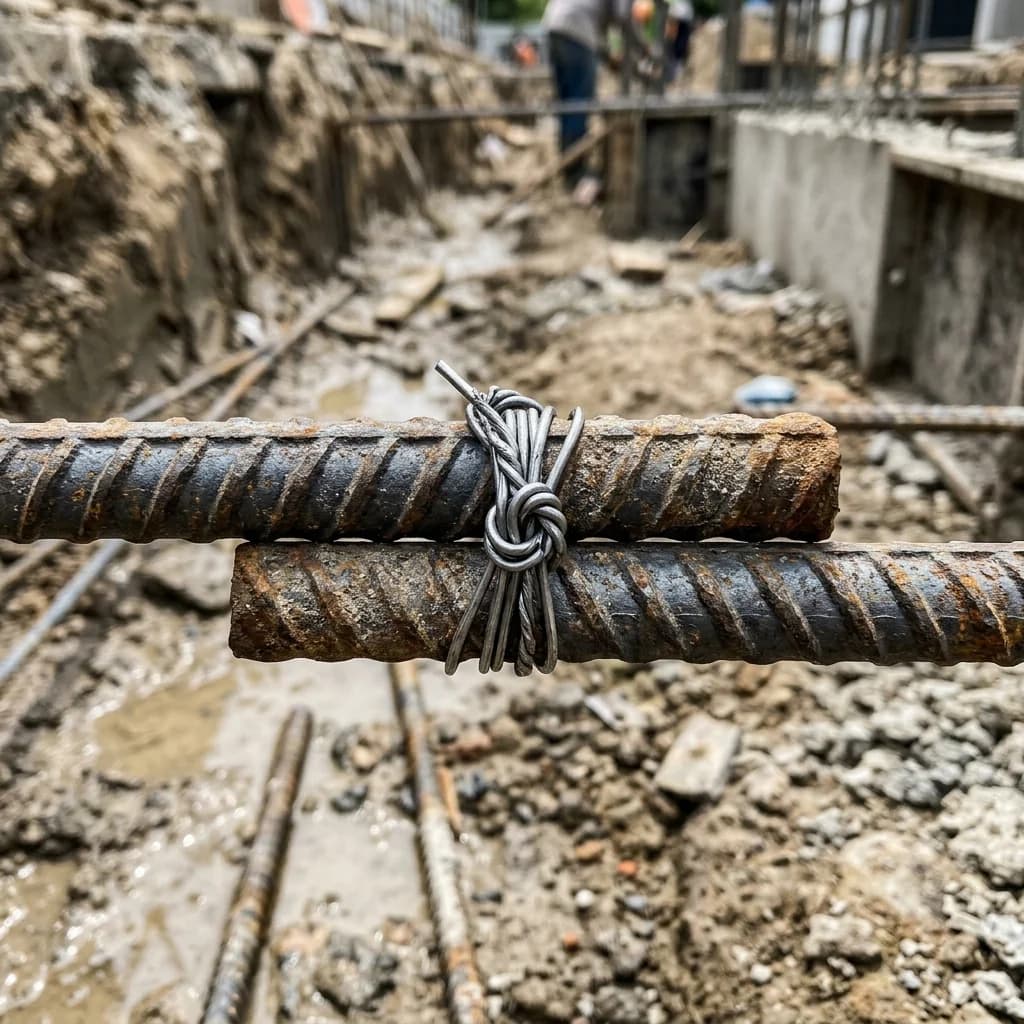
To maintain a continuous path of strength, the bars must overlap side-by-side by a specific distance and be tied tightly together with steel wire. This overlap is called a lap splice.
The standard lap splice length is governed by the bar's thickness and is typically calculated as 40 times the bar diameter (40d).
- For #3 rebar (3/8\" diameter): 15 inches of overlap.
- For #4 rebar (1/2\" diameter): 20 inches of overlap.
- For #5 rebar (5/8\" diameter): 25 inches of overlap.
3. Waste and Splice Buffer
Calculating the exact number of lap splices on a complex residential or commercial build can be incredibly tedious. To simplify estimation, professional builders calculate the pure theoretical linear footage of their layout and add a 10% to 15% waste factor. This buffer easily covers all overlaps, structural hooks, corner bends, and minor cutting errors.
The Importance of Rebar Spacers
Never lay rebar directly on the bottom of a trench. If you do, it will end up sitting on raw soil with zero concrete beneath it, leading to rapid corrosion and failure. Always elevate your steel grids using concrete blocks (called \"dobies\") or specialized plastic \"rebar chairs\" spaced every 3 to 4 feet to hold the steel perfectly in the middle of the pour.
How to Calculate Rebar for Continuous Trench Footings
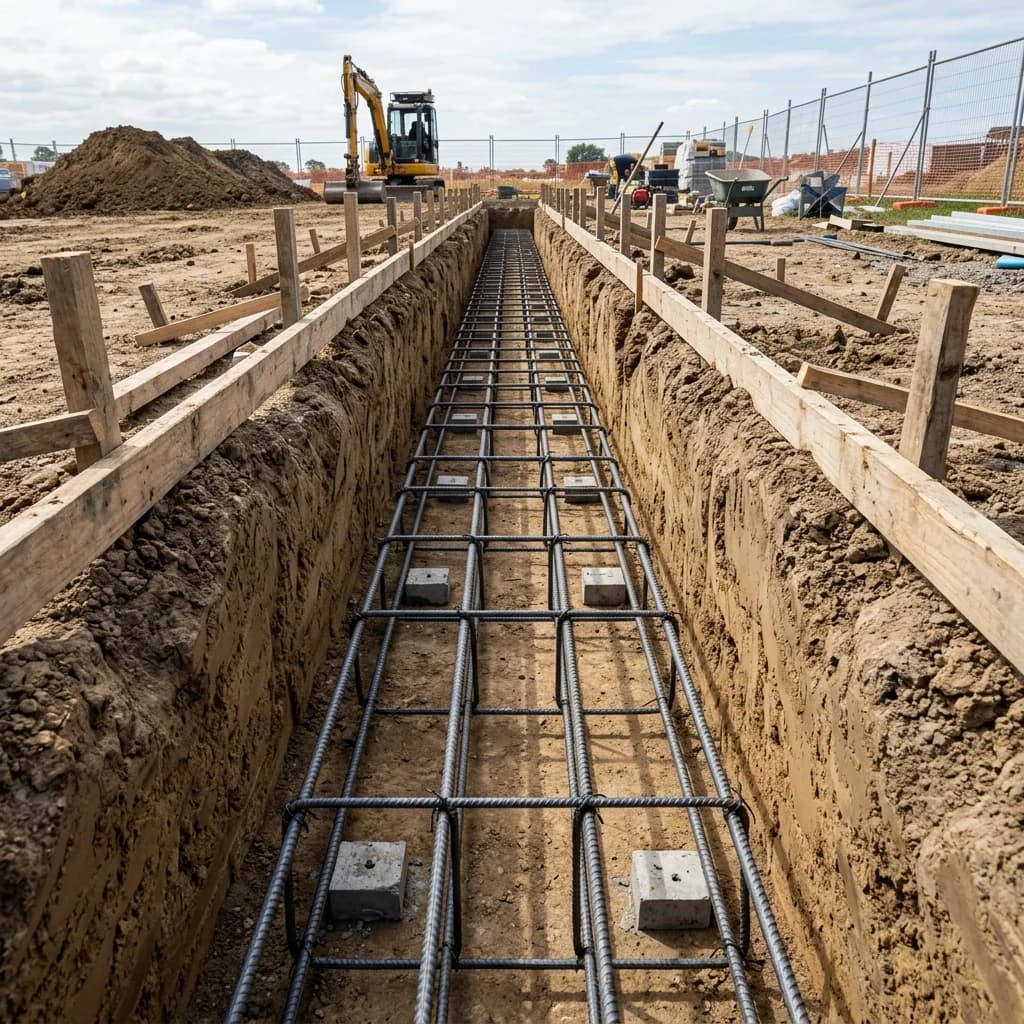
Continuous footings (also called wall or trench footings) run in a continuous line beneath the foundation walls. To calculate the total rebar needed, follow these steps:
- Find the Total Length: Measure the total perimeter of the trench (e.g., 120 feet).
- Identify the Number of Parallel Bars: Most building codes require at least two parallel runs of rebar running along the bottom of a residential trench footing. Heavy structures may require three or four.
- Deduct the Concrete Cover: Subtract 3 inches from the beginning and end of each run (6 inches total).
- Add the Splice Factor: Add a 10% buffer to account for lap splices.
Continuous Footing Rebar Length Formula
Where N is the number of parallel bars, P is the total footing perimeter, C is the concrete cover (0.25 ft / 3 inches), and w is the lap splice waste factor (e.g., 0.10 for 10%).
Example: A 120-foot perimeter footing with 2 parallel runs of #4 rebar and a 10% splice factor requires: 2 × (120 - 0.5) × 1.10 = 262.9 linear feet of steel.
How to Calculate Rebar for Isolated Pad Footings
Isolated pad footings (often called spot or column footings) are thick square or rectangular pads of concrete placed under individual support posts, deck piers, or structural columns.
Instead of running linearly, the rebar in a pad footing forms a grid (a criss-cross layout) running in both directions to handle bending forces in all planes.
To calculate rebar for a square pad footing (e.g., a 4' x 4' pad):
- Deduct Concrete Cover: 4 feet (48 inches) - 6 inches (3 inches on each side) = The rebar bars must be exactly 42 inches long (3.5 feet).
- Determine Number of Bars in Each Direction: Divide the usable width by the target spacing (typically 6 inches or 12 inches on-center) and add 1.
- Multiply by Both Directions: Sum the length of all bars running in both directions to get the total linear footage.
Isolated Pad Footing Grid Formula
Where W and H are the pad width and length, C is concrete cover, and S is the target on-center spacing of the grid.
Example: A 4' x 4' pad footing with rebar spaced 12 inches on-center (3 inches cover) requires: [ (3.5/1 + 1) × 3.5 ] + [ (3.5/1 + 1) × 3.5 ] ≈ 31.5 linear feet of steel.
Rebar Sizing and Weight Logistics
Rebar is sized in eighths of an inch. A simple trick to understand sizing is to read the bar number as a fraction over 8:
- #3 Rebar: 3/8-inch diameter. Extremely light-duty, primarily used for residential sidewalks or wrapping cages.
- #4 Rebar: 1/2-inch diameter (4/8\"). The absolute standard for residential slabs, driveways, and footings.
- #5 Rebar: 5/8-inch diameter (5/8\"). Used in commercial builds and heavy-duty structural foundation walls.
While you calculate rebar in linear feet, steel suppliers almost always price and ship materials by weight (pounds or tons). If you know your total linear footage, you can convert it to weight using these industry standard constants:
| Rebar Size | Diameter | Weight per Foot (lbs) |
|---|---|---|
| #3 | 3/8\" (0.375\") | 0.376 lbs/ft |
| #4 | 1/2\" (0.500\") | 0.668 lbs/ft |
| #5 | 5/8\" (0.625\") | 1.043 lbs/ft |
| #6 | 3/4\" (0.750\") | 1.502 lbs/ft |
Estimate with Confidence
Getting the rebar quantity right is about safety, budget control, and structural integrity. A minor mistake can compromise your foundation, leading to expensive shifts and settlement cracks decades down the road.
Before you head to the lumber yard or steel supplier, take the guesswork out of your estimates. Input your project's dimensions, cover clearance, and spacing directly into our professional online rebar length calculator to get instant, mathematically precise linear footages and total weight totals for your exact project needs!
Frequently Asked Questions
1. How deep must rebar be placed inside concrete footings?
For structural footings poured directly against undisturbed earth, building codes strictly require a minimum of 3 inches of concrete cover (clearance) around all sides of the steel. If the concrete is poured inside a wooden form above ground, the requirement is reduced to 2 inches. This clearance prevents moisture from infiltrating the concrete and rusting the steel.
2. What is a lap splice and how long should it be for footings?
A lap splice is the overlapping zone where two separate pieces of rebar meet side-by-side to ensure continuous structural load paths. The general code standard is an overlap of 40 times the bar's diameter (40d). For a standard residential #4 rebar (1/2-inch thick), the lap splice must be at least 20 inches long and bound securely with tie wire.
3. What is the standard rebar size for residential concrete footings?
The absolute standard for most light residential footings, deck piers, and retaining walls is #4 rebar (1/2-inch diameter). For larger two-story residential homes or structures built on unstable, clay-rich soil, engineers often upgrade the requirement to #5 rebar (5/8-inch diameter) to handle the increased load.
4. How do I convert rebar linear feet to pounds or tons?
To find the weight of rebar, multiply the total linear footage by the unit weight of the specific bar size you are using. For example, standard #4 rebar weighs 0.668 pounds per linear foot. If your footing requires 400 linear feet of rebar, your total weight is 400 × 0.668 = 267.2 pounds. (To convert to tons, divide the total pounds by 2,000).
References
Standards and data referenced in this guide. Building codes are adopted locally, so verify requirements with your jurisdiction before you build.
- Concrete design and construction standards — American Concrete Institute
- IRC 2021, Chapter 4 — Foundations (footing sizing, §R403) — International Code Council
- Construction material standards — ASTM International
About the Author

Hassan Baloch — An experienced Civil Engineer with more than a decade in building and structural planning. Hassan rigorously verifies the mathematical formulas and code compliance of our estimation tools to guarantee absolute precision. Contact our team for technical inquiries.