

Is Solar Worth It? A Homeowner's Guide to Panel Costs and Payback
Decide whether solar makes sense for your home. Compare installation costs, tax credits, typical payback periods, and property value impact — then run the numbers in our free solar calculator.
Installing solar panels is one of the smartest upgrades you can make to a modern home — but only if the numbers work for your roof, your utility rates, and your budget. This guide answers the practical questions homeowners ask first: what does it cost, how long until it pays for itself, and is it worth it compared to staying on the grid?
For the full engineering math — peak sun hours, system derating, panel counts, and payback formulas — read our companion guide, The Math Behind Solar Payback. When you are ready to run your own numbers, use our free Solar Panel Sizing & ROI Calculator.
Two guides, two purposes
- This guide — practical overview for homeowners deciding whether to go solar.
- The Math Behind Solar Payback — step-by-step formulas for sizing arrays and calculating ROI.
1. What is Solar Panel ROI and Payback Period?
Return on Investment (ROI) is a simple way to measure how much financial benefit you gain from an upfront cost. For solar energy, your ROI is the total amount of money you save on electricity bills over the lifespan of the panels, minus the initial cost of buying and installing them.
The solar panel payback period is the amount of time it takes for your energy savings to equal the initial cost of the system. For example, if your solar system costs $15,000 after tax credits, and it saves you $1,500 a year on your electricity bill, your payback period would be 10 years. Since modern solar panels typically last 25 to 30 years, you will enjoy 15 to 20 years of essentially free electricity after the system pays for itself.

2. Understanding the Cost of Solar Panels for Home
When you start your research, the first question is usually: What is the true cost of solar panels for home installations? The answer depends on several factors, including the size of your house, your current energy usage, and the quality of the panels you choose.
On average, a standard residential solar system in the United States costs between $15,000 and $25,000 before any tax incentives. However, the Federal Solar Investment Tax Credit (ITC) allows you to deduct a significant percentage of the installation cost from your federal taxes. Local state and utility incentives can drive the final cost down even further.
To accurately plan for these expenses, especially during a new build or a major renovation, you can use our Construction Cost Calculator to integrate solar costs into your overall project budget.
3. How a Residential Solar Savings Estimator Works
A residential solar savings estimator takes the guesswork out of planning. These estimators typically use your location, your average monthly electricity bill, and your roof size to calculate your potential savings.
The amount of sunlight your roof receives directly impacts how much energy your panels will produce. A roof facing south without shade from trees will generate the maximum amount of electricity. An estimator factors in these geographical details, alongside the rising costs of traditional electricity from utility companies, to project your savings over 20 to 25 years.

4. Solar Panel Installation Cost Analysis
A thorough solar panel installation cost analysis goes beyond the panels themselves. Here is a breakdown of what makes up the total installation cost:
- Equipment (Solar Panels and Inverters): This makes up about 40% to 50% of the total cost. High-efficiency panels cost more upfront but generate more electricity over time.
- Labor and Installation: Professional installation is critical. This accounts for roughly 10% to 15% of the cost. Using experienced installers ensures the system is safely integrated into your home's electrical grid and roof.
- Permits, Taxes, and Interconnection: Depending on your local government, you will need permits to install panels and connect them to the grid. These soft costs usually make up about 20% of the total budget.
- Mounting Hardware: The hardware that secures the panels to your roof makes up the remaining balance. If your roof needs repairs before installation, check pitch and surface area with our Roof Pitch Calculator before scheduling work.
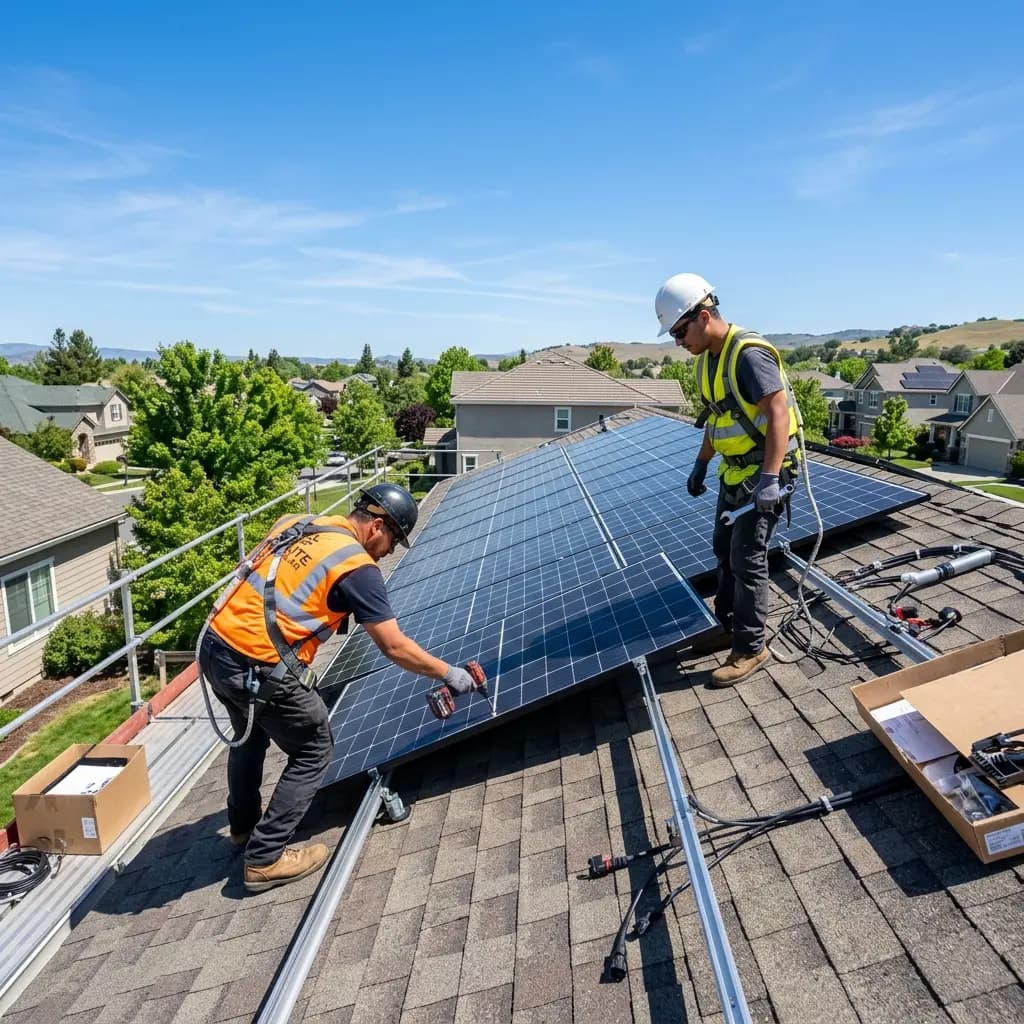
5. The Long-Term Benefits of Going Solar
Beyond lowering your monthly utility bills, going solar has an excellent return on investment because it actively increases your property value. Studies show that homes with solar energy systems sell for more money than homes without them. Buyers love the idea of moving into a house where the electricity bill is minimal.
Additionally, you are contributing to a cleaner environment by reducing carbon emissions. With utility rates historically rising every year, locking in your energy costs now by producing your own electricity is a solid financial strategy.
Frequently Asked Questions
How do I calculate my solar panel ROI?
To calculate your ROI, add up your total estimated energy savings over the lifespan of the panels (usually 25 years). Then, subtract the total cost of the system (after tax credits). Divide the net profit by your initial investment to find your percentage return.
What is a good solar panel payback period?
A good payback period for residential solar panels is typically between 6 and 10 years. This depends heavily on your local electricity rates, the amount of sunlight your home receives, and the available local and federal tax incentives.
Does the cost of solar panels for home include roof repairs?
No, the standard cost of a solar system does not include replacing or repairing an old roof. If your roof needs replacing soon, do that before installing panels. Use our Roof Pitch Calculator to check whether your slope and orientation suit solar, and read Roof Pitch vs. Angle for measuring guidance.
Can I trust a residential solar savings estimator?
Yes, reputable online savings estimators are very accurate. They use satellite imagery to check your roof's sun exposure and cross-reference it with local utility rates to provide a highly realistic estimate of your potential savings.
References
Standards and data referenced in this guide. Building codes are adopted locally, so verify requirements with your jurisdiction before you build.
- PVWatts Calculator — modelled solar output by location — National Laboratory of the Rockies
- Average retail electricity prices by state — U.S. Energy Information Administration
- Residential solar guidance and research — U.S. Department of Energy, Solar Energy Technologies Office
About the Author

Zain Sheikh — With over 10 years of hands‑on experience in residential and commercial construction, Zain ensures that every calculator on our platform accounts for real‑world variables, waste factors, and site conditions. Contact our team for technical inquiries.
Related Guides

The Math Behind Solar Payback: How to Calculate Panel ROI and Utility Savings
Engineering-level solar math: peak sun hours, system derating, panel counts, tax credits, and payback formulas. Use with our Solar Panel Calculator for precise sizing.
Understanding R-Value in Home Insulation
Learn what R-Value means, how to measure heat flow, and exactly how much insulation your attic and walls need using our professional insulation calculator.
Related Calculators
Solar Panel Calculator
Estimate recommended solar system size, panel count, net costs, tax credits, and payback ROI.
Roof Pitch Calculator
Determine roof pitch, angle, rafter length, and area.

Construction Cost
High-level cost estimator for new builds.