
Comprehensive Guide to Residential Solar Sizing, Costs, and Payback ROI

Transitioning your home or building to solar energy is a significant financial and structural investment. Whether you are a general contractor planning a green home build or a homeowner looking to offset rising utility bills, understanding how a solar array is sized, how solar radiation is converted to usable energy, and how the financial payback models work is critical. This guide breaks down the underlying physics, system sizing formulas, roof structure requirements, and the financial math behind residential solar arrays.
Solar Panel Sizing: The Core Math & Formulas
Solar panel systems are rated in terms of **DC (Direct Current) Watts**, which is the total capacity the panels can produce under perfect Standard Test Conditions (STC). However, standard household appliances operate on **AC (Alternating Current)**.
To size a solar system that covers 100% of your energy usage, we must calculate your annual consumption, convert it to a daily target, and factor in localized sunlight hours alongside system efficiency losses.
Core Solar System Sizing Formula
System Size (kW) = (Daily Energy Needed ÷ (Daily Sun Hours × 0.78))
Where Daily Energy Needed is in kWh, Daily Sun Hours depends on geographic location, and 0.78 is the DC-to-AC derate factor (accounting for inverter conversion loss, temperature coefficient, dirt, and wire resistance).
Understanding the Variables in Solar Calculations
- Annual Consumption (kWh): This is the total kilowatt-hours of electricity your home consumes over 12 months. Sizing is based on a full year because energy bills fluctuate significantly between hot summer months (AC cooling loads) and cold winter months.
- Peak Sun Hours vs. Standard Daylight Hours (Scientific Distinction): There is a profound scientific and meteorological distinction between ambient daylight hours and true Peak Sun Hours. Standard daylight hours span the entire duration between sunrise and sunset—including overcast periods, dawn, and dusk when the sun is at a low angle. During these hours, solar radiation is highly diffused and lacks the intensity required to drive substantial photovoltaic generation. In contrast, a Peak Sun Hour is a unit of solar measurement defined as any hour where solar irradiance reaches an average of 1,000 Watts of light energy per square meter (1 kW/m²) striking the Earth's surface. A sunny summer day might provide 14 hours of ambient daylight, but only yield 5.2 Peak Sun Hours of usable solar fuel. Sizing formulas rely exclusively on Peak Sun Hours to ensure the electrical current generated meets actual home demands.
- The 1.3 System Degradation Multiplier (30% Loss Engineering Necessity): In pure laboratory conditions under Standard Test Conditions (STC), solar panels operate at 100% of their nameplate wattage. In the real world, however, an array experiences a continuous, compounding stream of efficiency losses. These include microinverter/string inverter heat conversion losses (typically 3% to 5%), solar cell temperature degradation (as panels heat up in summer, their voltage drops), dust, pollen, or soot accumulation on the glass face (known as "soiling losses" which rob another 2% to 5%), and cable voltage drop due to electrical resistance over long wire runs.
To combat this, solar engineers apply a 30% real-world loss modifier (a 1.3 system degradation multiplier) to their sizing math. Dividing your daily energy need by localized peak sun hours alone will catastrophically undersize your system. Multiplying the ideal target size by a factor of 1.3 (mathematically equivalent to applying the industry-standard 78% DC-to-AC derating factor) is an absolute engineering necessity to secure realistic, year-round utility displacement. - Target Panel Wattage: Modern residential solar panels generally produce between 350 and 450 Watts of power. Higher wattage panels require fewer physical units on the roof but carry a higher upfront hardware premium.
Roof Layout and Sizing by Available Space
Sometimes, you are not sizing a solar array based on your electric bill; instead, you are limited by the physical **available space** on your roof. This is a common bottleneck for small homes, multi-story buildings, or complex roof geometries with multiple hips and valleys.
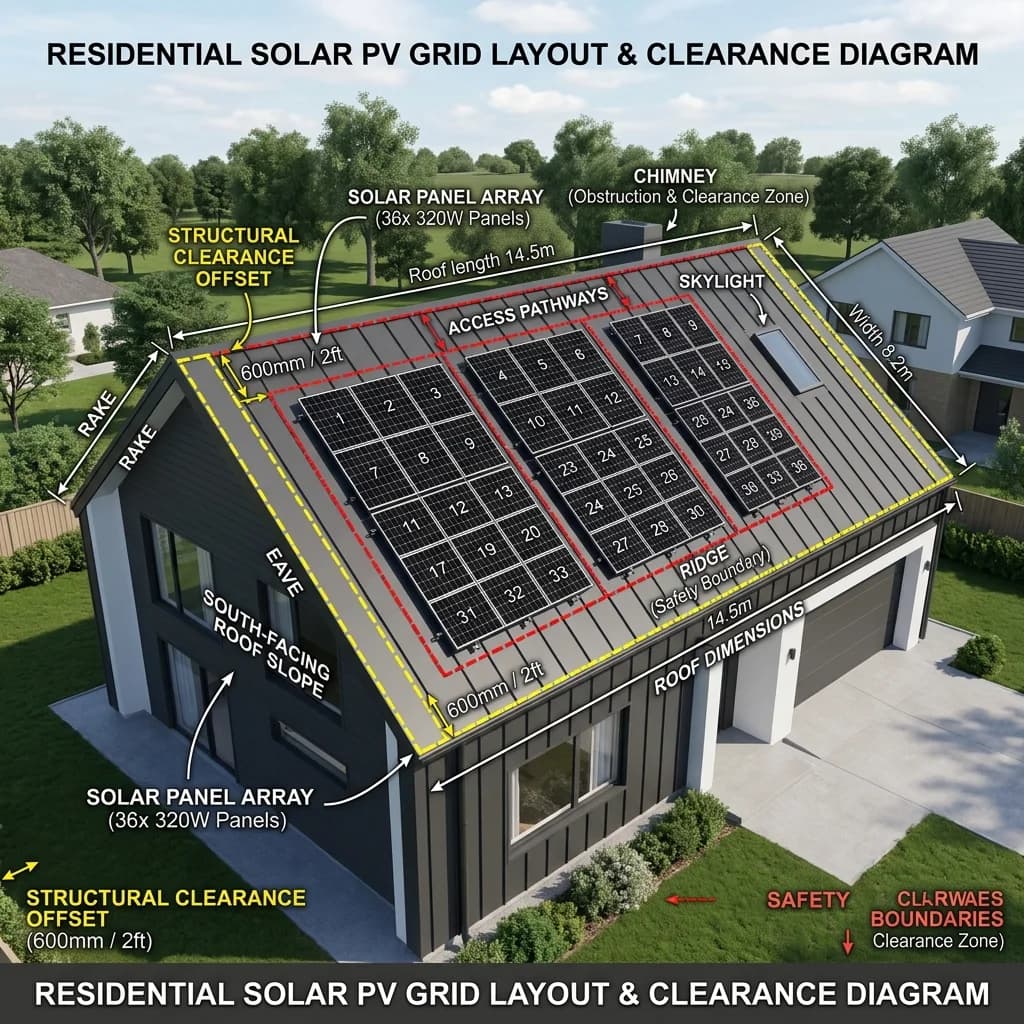
A standard residential solar panel is approximately **5.4 feet long by 3.25 feet wide**, which occupies roughly **17.5 square feet (1.63 square meters)** of surface area. When laying out a solar array, builders must respect local building codes, which usually require a **3-foot perimeter pathway** around the edges of the roof for firefighter access and ventilation.
Space-Based Sizing Example:
Suppose you have a clear, South-facing roof area of 500 square feet.
Using standard 400W panels (occupying 17.5 sq ft each):Max Panels = 500 sq ft ÷ 17.5 sq ft/panel = 28.57 → 28 panels.
A 28-panel system using 400W panels yields a **11.2 kW** system capacity (28 × 400W = 11,200W).
Solar Economics: Payback ROI, Costs, and Incentives
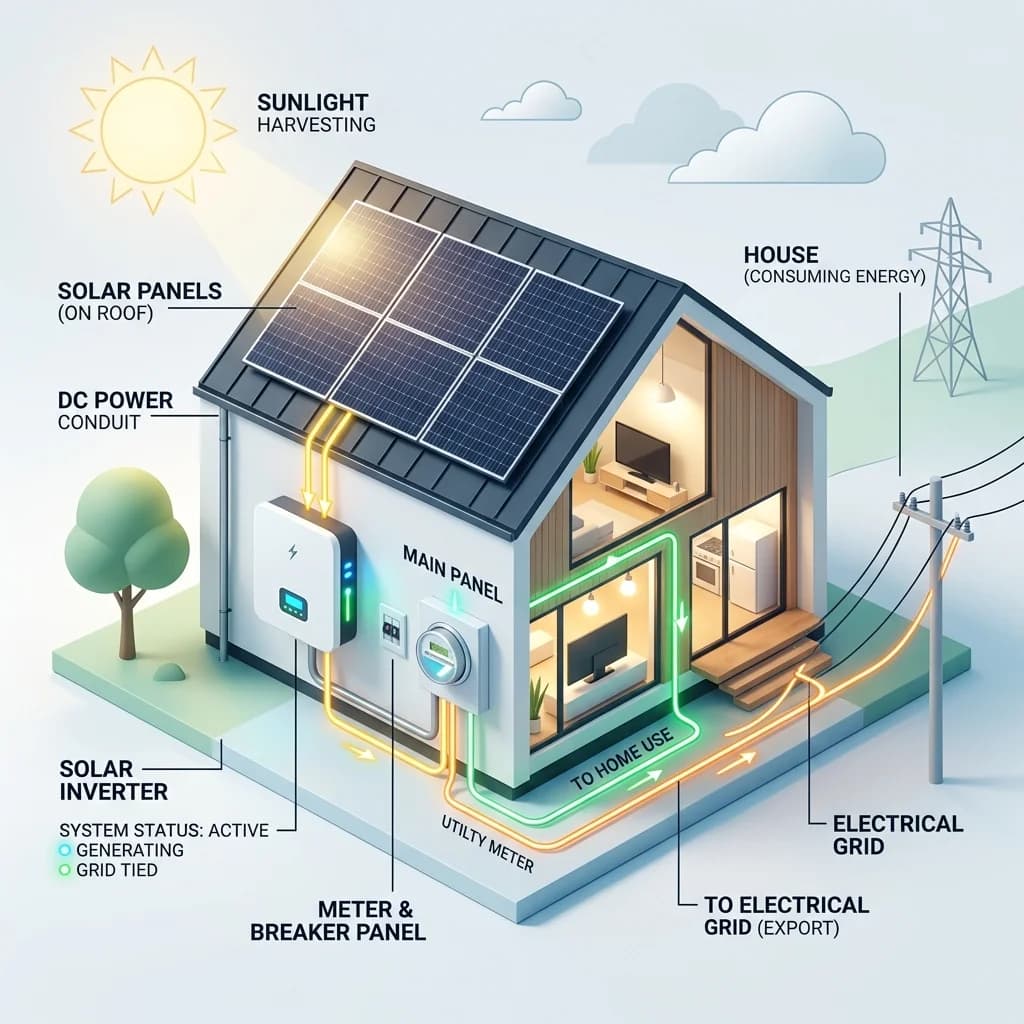
Sizing is only half of the equation; understanding the financial investment is crucial for structural budgeting. Residential solar installations are typically estimated based on a **Cost per Watt** basis.
Currently, the average national cost of residential solar is between **$2.80 and $3.20 per Watt** before incentives. That means a 10 kW (10,000 Watts) system has an initial gross price tag of about **$30,000**.
The 30% Federal Investment Tax Credit (ITC)
To make clean energy more accessible, the US federal government offers a massive **30% Investment Tax Credit (ITC)**. This is a dollar-for-dollar reduction in your federal income tax liability.
For a $30,000 system, the tax credit is **$9,000** ($30,000 × 0.30). This lowers your actual net out-of-pocket investment to **$21,000**. If you do not have enough tax liability to use the entire $9,000 in the first year, you can roll the remaining balance over to subsequent tax years.
Annual Bill Savings & Payback Timeline
The payback period (the time it takes for the system to pay for itself) is calculated by dividing your net system cost by your annual electricity savings.
With **Net Metering**, any power your panels feed back to the grid during sunny hours offsets the energy you draw at night. If your system is sized to offset 100% of your usage, your annual savings will equal your pre-solar electricity bill.
For a net investment of $21,000 and an average monthly bill of $175 ($2,100 per year), your payback period would be exactly **10 years** ($21,000 ÷ $2,100/yr). After year 10, the system generates completely free electricity, locked in against future utility price hikes.
Crucial Construction & Engineering Considerations
Before bolting solar mounting racks onto a roof, structural integrity and layout must be carefully evaluated by a builder or structural engineer:
- Roof Structural Capacity: Modern solar arrays weigh approximately **3 to 4 pounds per square foot** (including racking, wiring, and panels). While most modern roofs can easily handle this dead load, older rafters or trusses should be inspected for sagging or rot.
- Age of Roofing Material: Solar panels are designed to last **25 to 30 years**. If your asphalt shingle roof is already 15 years old and nearing the end of its lifespan, it is highly recommended to replace the shingles *before* installing solar. Removing and reinstalling a solar array just to lay down new shingles can cost between $3,000 and $6,000 in labor.
- Roof Pitch and Orientation: The absolute ideal roof pitch is between **30° and 40° (6/12 to 10/12 pitch)**, pointing directly South. East and West-facing roofs are also highly viable but suffer a minor 15% efficiency penalty. North-facing pitches should be avoided as they receive zero direct light and rarely break even.
Disclaimer: The financial models, solar output data, and construction specifications provided in this guide are for planning and informational purposes only. Local utility solar policies, municipal permitting fees, regional solar irradiance, and state tax credits vary heavily. Always consult with a certified structural engineer and a licensed NABCEP solar installer before mounting solar hardware.