Standard Brick Sizes and Mortar Math: A Masonry Guide for DIYers and Builders
Learn how to calculate brick counts and mortar ingredients with precision. A complete guide to standard brick dimensions, mortar types, and masonry mathematics.
At first glance, masonry looks like one of the simplest construction tasks on the planet. You take a brick, apply a layer of wet mortar, place it on the wall, and repeat. However, anyone who has ever attempted a DIY garden wall, a mailbox surround, or a fire pit quickly learns that bricklaying is just as much about mathematics as it is about physical work.
If you get the math wrong, you face two frustrating outcomes. Either you order too few bricks and have to pay a second delivery fee while your project sits half-finished, or you end up with hundreds of expensive leftover bricks cluttering your yard.
To avoid these costly mistakes, you need to understand two key concepts: the actual versus nominal sizes of bricks, and the math of mortar joint spacing. In this comprehensive guide, we will break down standard brick sizes, explain the role of mortar joint dimensions, outline the standard formulas for brick estimation, and show you how to choose the right mortar mix. We will also link you to our dedicated Brick & Mortar Calculator to help you run these numbers automatically.
1. Brick Dimensions: Actual vs. Nominal Sizes
The first step in masonry math is knowing the size of your brick. However, if you measure a standard "Modular" brick with a tape measure, you will notice it does not measure exactly 8 inches.
This is because masonry uses two sets of dimensions:
- Actual Size: The physical, dry dimensions of the brick itself as it comes out of the kiln.
- Nominal (Coordinating) Size: The actual size plus the width of one standard mortar joint (usually 3/8 inch or 10mm).
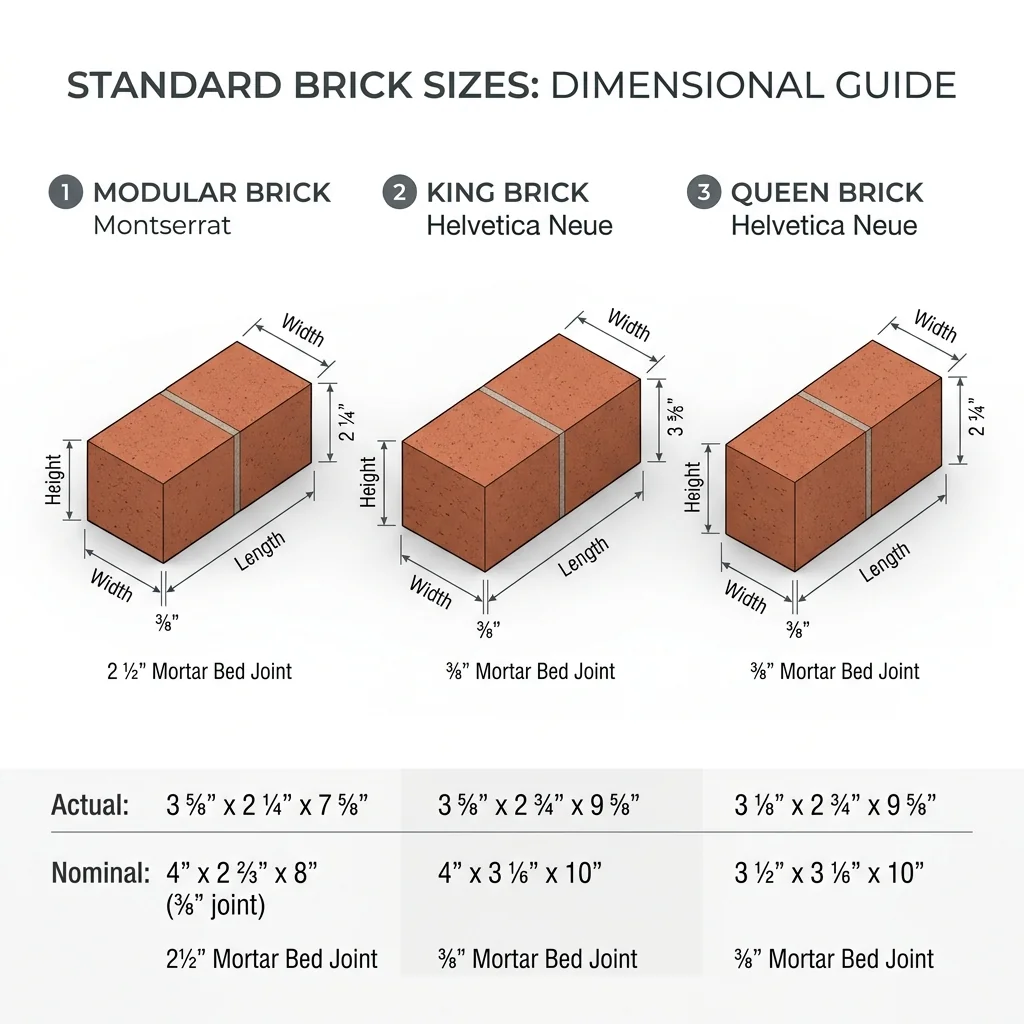
Nominal sizes are designed to fit into a clean grid system. For instance, a standard modular brick has an actual size of 7 5/8 inches long by 3 5/8 inches wide by 2 1/4 inches high. When you add a 3/8-inch mortar joint to each dimension, the nominal size becomes a clean 8 inches long, 4 inches wide, and 2 2/3 inches high. This means that exactly three courses of modular bricks, including mortar joints, will equal 8 inches in height (3 × 2.67 inches = 8 inches).
Here is a detailed comparison table of the most common brick sizes used by builders and DIYers:
| Brick Type | Actual Size (W × H × L) | Nominal Size (W × H × L) | System |
|---|---|---|---|
| Modular | 3 5/8" × 2 1/4" × 7 5/8" | 4" × 2 2/3" × 8" | US Imperial |
| King | 3" × 2 5/8" × 9 5/8" | 3 3/8" × 3" × 10" | US Imperial |
| Queen | 3 1/8" × 2 3/4" × 9 5/8" | 3 1/2" × 3 1/8" × 10" | US Imperial |
| Roman | 3 5/8" × 1 5/8" × 11 5/8" | 4" × 2" × 12" | US Imperial |
| Utility | 3 5/8" × 3 5/8" × 11 5/8" | 4" × 4" × 12" | US Imperial |
| Standard Metric | 102.5 × 65 × 215 mm | 112.5 × 75 × 225 mm | UK / Metric |
2. The Geometry and Purpose of the Mortar Joint
Why do we leave a gap between bricks instead of stacking them raw?
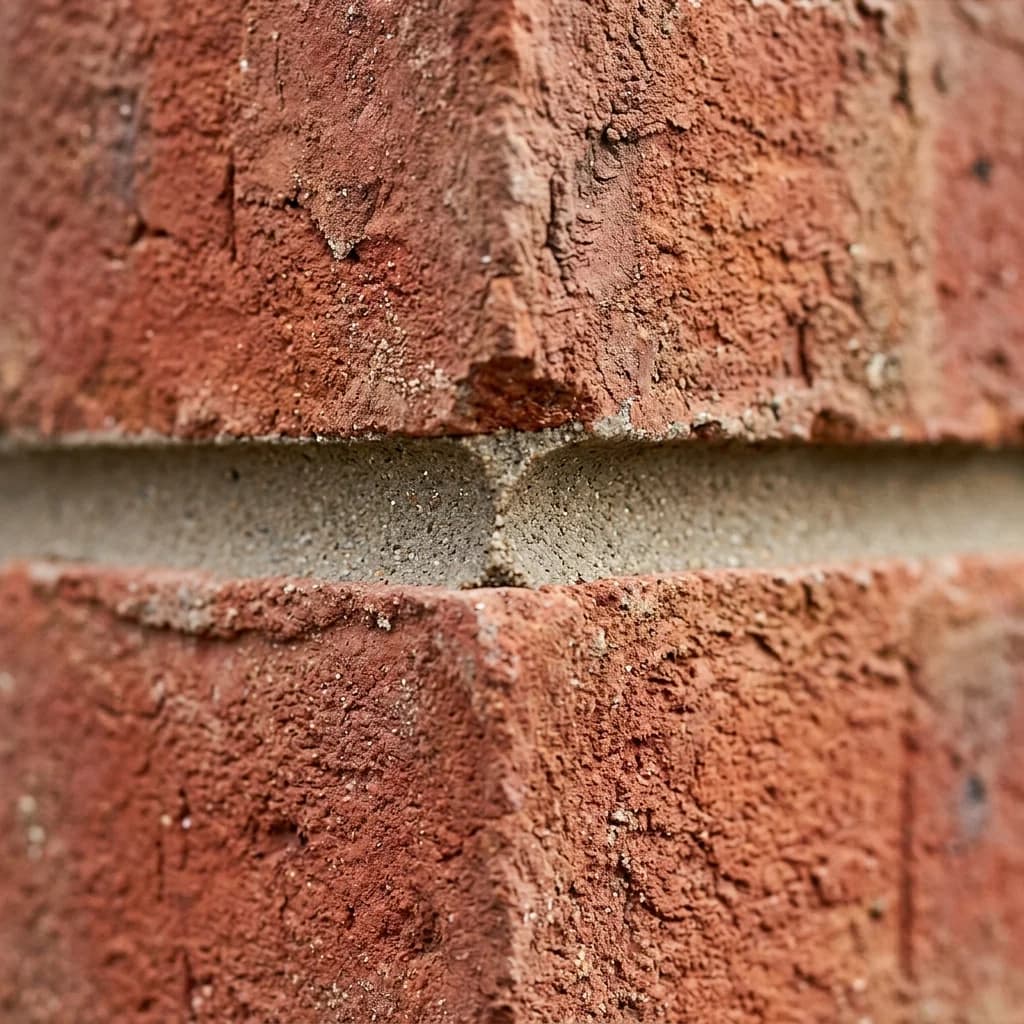
A mortar joint is not just space; it has vital functions:
- Bonds the Wall: It is the adhesive that holds individual clay units together so they act as a single wall.
- Distributes Weight: It cushions the bricks and distributes load evenly across the entire surface, avoiding stress points.
- Absorbs Variations: Bricks are natural clay products that shrink slightly differently in the kiln. The mortar joint allows the mason to absorb these small differences and keep courses perfectly level.
The standard thickness of a mortar joint in the US is **3/8 inch (9.5 mm)**, and in metric systems, it is **10 mm**. If you make the joint too thin (e.g., 1/4 inch), the mortar won't have enough thickness to bond properly and will fail. If you make it too thick (e.g., 1/2 inch or more), you weaken the wall because mortar has lower structural strength than the brick.
Importantly, the mortar joint occupies about **15% to 20% of the total wall volume**. If you calculate your brick count using the actual size of the brick instead of the nominal size, you will overestimate your brick needs by that same 15% to 20%!
3. Calculating Brick Counts: The Math
To calculate the number of bricks required for a wall, we divide the total wall area by the nominal face area of one brick (which includes the mortar joint).
Brick Count Formula
Where L is the actual length of the brick (inches), H is the actual height (inches), J is the mortar joint thickness (usually 3/8"), and Awall is the wall area in square feet.
For a standard modular brick, this simplifies to: 80 sq.ft. wall × 6.75 bricks/sq.ft. = 540 bricks.
Let's walk through a real-world example:
Suppose you are building a garden wall that is 20 feet long and 4 feet high using Modular Bricks.
- Calculate Wall Area: Length × Height = 20 × 4 = **80 square feet**. (Exclude doors or windows if any, using our Wall Square Footage Calculator).
- Calculate Brick Face Area: A modular brick is 7 5/8" long × 2 1/4" high. Add 3/8" to both dimensions for nominal size: 8" long × 2 2/3" (2.67") high. Nominal Face Area = 8 × 2.667 = **21.33 square inches**.
- Convert to Square Feet: 21.33 ÷ 144 = **0.148 square feet per brick**.
- Divide Wall Area by Brick Area: 80 ÷ 0.148 = **540 bricks**.
This gives us a helpful rule of thumb for standard modular bricks in a single-skin (half-brick) wall: you need approximately **6.75 bricks per square foot** of wall surface area.
If you are using metric standard bricks (215mm × 102.5mm × 65mm) with a 10mm mortar joint:
- Nominal Size: 225mm × 112.5mm × 75mm (or 0.225m × 0.1125m × 0.075m).
- Face Area: 0.225m × 0.075m = **0.016875 square meters**.
- Divide Wall Area: 1 ÷ 0.016875 = **59.25 bricks per square meter**.
This gives us the standard metric rule of thumb: you need exactly **60 bricks per square meter** of wall area.
Double-Skin Walls
If you are building a double-skin wall (often called a one-brick wall, where two layers of bricks are laid side-by-side for load-bearing strength), you must **double the final count** (e.g. 13.5 bricks per square foot or 120 bricks per square meter) and add metal wall ties to connect the layers.
4. Bonding Patterns and Their Material Impact
How you arrange your bricks affects both the appearance and the number of bricks required.
- Running Bond: The simplest and most common pattern. Bricks are laid horizontally in stretchers (long side facing out) with vertical joints overlapping halfway. This pattern has minimal cuts and requires standard math.
- Common (American) Bond: Standard running bond courses interrupted every 5th or 6th course by a course of headers (short side facing out). Headers tie the wall structurally to a backup wall, but expose the 3 5/8" end instead of the 7 5/8" side, requiring more bricks.
- English Bond: Alternates courses of headers and stretchers. This pattern is structurally strong but requires more bricks and more mortar because you are laying twice as many headers.
- Flemish Bond: Alternates stretchers and headers in every single course. This requires meticulous layout and creates a high amount of offcut waste at the ends of walls.
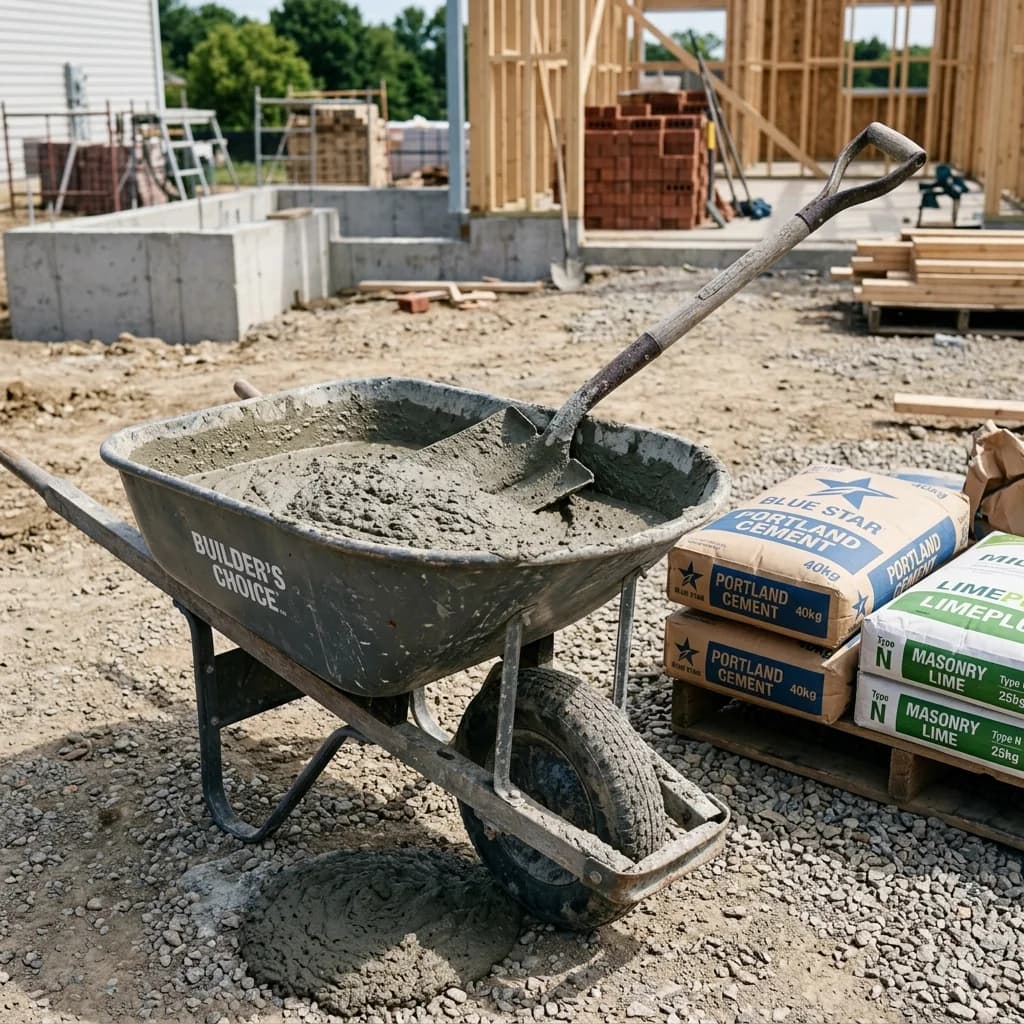
5. Mortar Mixes and Ingredient Math
Bricks represent only half of your material list. You must also calculate the cement, lime, and sand required to bind them.
Mortar is classified into four standard types based on its compressive strength and flexibility, designated by every other letter of the phrase **"MaSoN wOrK"**:
- Type M (2,500 PSI): Very high strength. Used for heavy load-bearing structures, foundations, retaining walls, and below-grade masonry.
Ratio: 1 part Cement, 1/4 part Hydrated Lime, 3 parts Sand. - Type S (1,800 PSI): High strength. Excellent structural bonding for above or below-grade walls, patios, and regions prone to high winds or earthquakes.
Ratio: 1 part Cement, 1/2 part Hydrated Lime, 4.5 parts Sand. - Type N (750 PSI): Medium strength. The **standard choice for general residential masonry**, chimneys, above-grade exterior walls, and garden walls. It provides the best balance of strength and flexibility to prevent cracking from temperature changes.
Ratio: 1 part Cement, 1 part Hydrated Lime, 6 parts Sand. - Type O (350 PSI): Low strength. Used primarily for interior partition walls and historic restoration of old brick walls where soft bricks require a softer, flexible mortar joint.
Ratio: 1 part Cement, 2 parts Hydrated Lime, 9 parts Sand.
Estimating Mortar Quantities
How much mortar do you need to buy?
As a standard rule of thumb:
- For every **1,000 modular bricks** with a 3/8" joint, you will need approximately **30 to 37 cubic feet of wet mortar** (which is about 1.1 to 1.3 cubic yards).
- If you use pre-mixed bags of mortar (just add water), a single **80 lb bag** typically lays about **30 modular bricks**. Therefore, for 1,000 modular bricks, you will need about 33 to 34 bags of pre-mix mortar.
- If you are mixing from scratch, for every 1,000 modular bricks using Type N mortar, you will need approximately **7 bags of Portland cement (94 lbs each)**, **7 bags of hydrated lime (50 lbs each)**, and **1 cubic yard of masonry sand** (approx. 1.2 tons).
6. Factoring in Waste: The 10% Rule
No project is mathematically perfect. Bricks get dropped, snap in transit, or get cut into half-bricks at corners and openings.
To ensure you do not run short mid-build:
- For simple straight walls with few corners, add a **5% waste factor**.
- For complex walls with windows, doors, and multiple corners, add a **10% waste factor**.
Read more about why adding waste factors is crucial in our comprehensive Construction Waste Factor Guide.
Summary: Run the Math Automatically
Doing all these calculations by hand can be tedious and prone to errors. To make your planning easy, enter your project dimensions directly into our professional Brick & Mortar Calculator. It will immediately output the total number of bricks, accounting for your chosen brick type, mortar joint width, waste factor, and provide the exact weights and bags of cement, lime, and sand required to finish your project flawlessly.
Frequently Asked Questions
1. What is the difference between actual and nominal brick sizes?
Actual size is the physical measurement of the dry brick itself. Nominal size includes the thickness of one mortar joint (usually 3/8 inch or 10mm). Nominal sizes allow brickwork to fit into clean, grid-like standard modules.
2. How many modular bricks are in a square foot?
You need approximately 6.75 modular bricks per square foot of wall surface area for a standard single-skin wall. For a double-skin wall, you need 13.5 bricks per square foot.
3. Which mortar type is best for general DIY garden walls?
Type N mortar is the best general-purpose option for above-grade residential work, garden walls, and chimneys. It offers a moderate compressive strength of 750 PSI and excellent flexibility, which prevents cracking.
4. Can I use regular concrete mix as mortar?
No. Concrete mix contains coarse gravel, which makes it impossible to lay thin, level mortar joints. Concrete is also too stiff and shrinks significantly when curing, which will crack your bricks. Always use masonry mortar mix.
5. How many bricks are on a standard pallet?
A standard pallet typically holds 500 modular bricks (weighing about 2,000 to 2,400 lbs). Always double-check with your local distributor as pallet packaging sizes can vary.
References
Standards and data referenced in this guide. Building codes are adopted locally, so verify requirements with your jurisdiction before you build.
- Technical Notes on Brick Construction (sizing and mortar) — Brick Industry Association
- Construction material standards — ASTM International
About the Author

Hassan Baloch — An experienced Civil Engineer with more than a decade in building and structural planning. Hassan rigorously verifies the mathematical formulas and code compliance of our estimation tools to guarantee absolute precision. Contact our team for technical inquiries.