
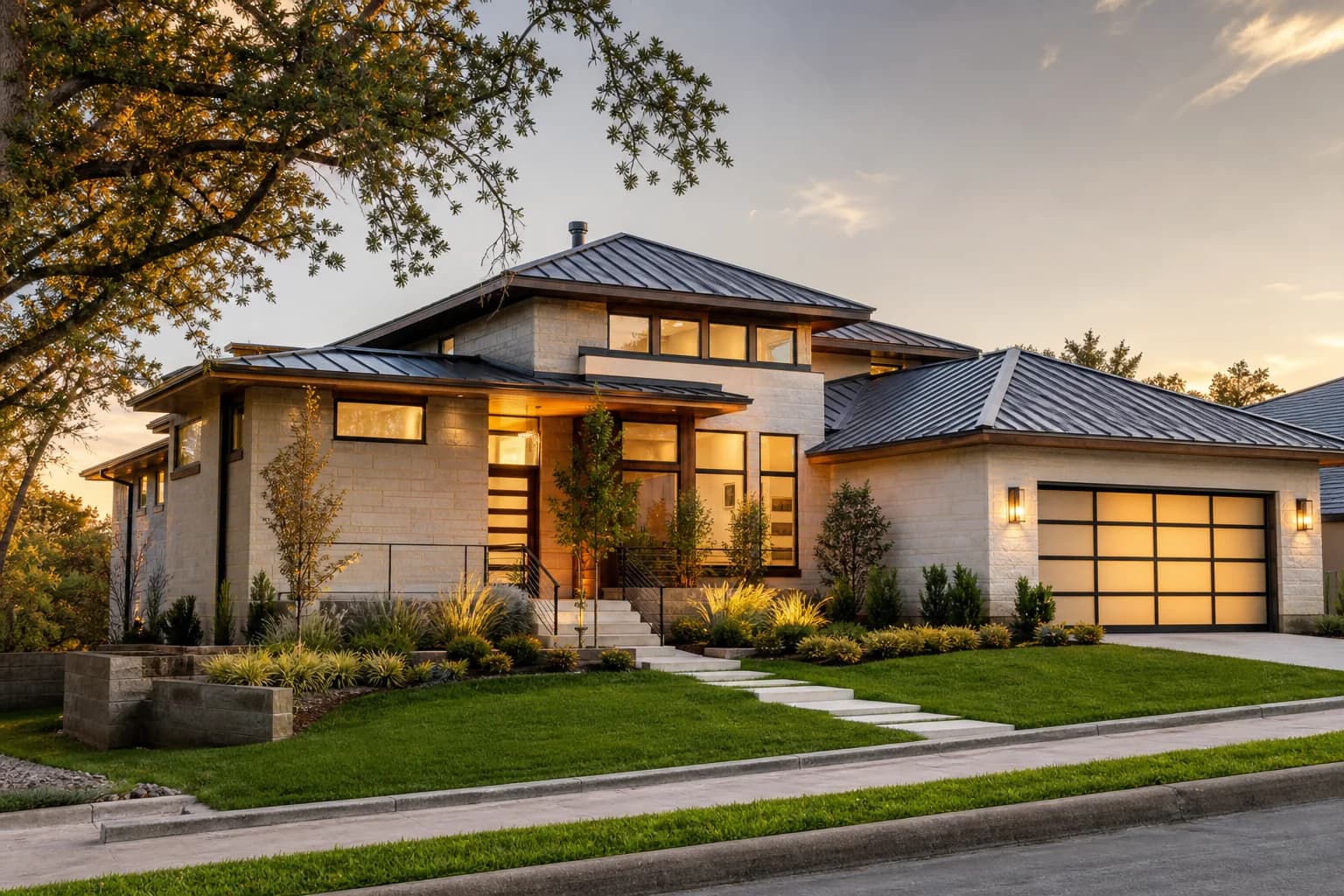
What Is Residential Architecture? A Complete Guide for Homeowners
Learn what residential architecture is, what a residential architect does, how the design process works, common home styles, and when you need professional architectural help for your project.
Every home you have ever lived in — from a small starter bungalow to a sprawling custom estate — began as an idea shaped by residential architecture. This is the branch of architecture focused entirely on designing places where people live. It covers single-family houses, townhomes, duplexes, apartments, and every other dwelling type built for daily life rather than business or industry.
Whether you are planning a new build, a major addition, or simply trying to understand the drawings your contractor handed you, knowing the basics of residential architecture helps you make smarter decisions. This guide explains what residential architecture is, breaks down exactly what a residential architect does, and walks you through the design process, common home styles, and the tools you can use to plan your project with confidence.
What Is Residential Architecture?
Residential architecture is the art and science of designing buildings where people live. Unlike commercial architecture — which focuses on offices, retail stores, hospitals, and factories — residential architecture prioritizes comfort, privacy, family routines, and the emotional feeling of "home."
A residential architect thinks about how sunlight enters the kitchen in the morning, whether the master bedroom is far enough from noisy living areas, how rain drains away from the foundation, and whether a hallway is wide enough for a stroller or wheelchair. Every decision connects to how real people will use the space every single day.
Residential architecture also must satisfy building codes, zoning laws, energy standards, and structural engineering requirements. A beautiful floor plan that violates fire egress rules or overloads a foundation wall will never receive a building permit. Good residential design balances aesthetics, function, safety, and budget.
Residential vs. Commercial Architecture
| Factor | Residential | Commercial |
|---|---|---|
| Primary goal | Comfort, privacy, livability | Efficiency, capacity, revenue |
| Scale | 1–10 units typical | Large floor plates, multi-story |
| Codes | IRC (International Residential Code) | IBC (International Building Code) |
| Client | Homeowner or small developer | Corporations, institutions |
Most homeowners interact with residential architecture when they buy a tract home designed by a production builder, hire an architect for a custom house, or renovate an existing structure. Understanding this distinction helps you know which professionals and regulations apply to your project.
What Does a Residential Architect Do?

A residential architect is a licensed design professional who plans homes from concept through construction. Their job goes far beyond drawing pretty pictures. Here is what a residential architect typically handles:
- Programming: Meeting with you to understand how your family lives — number of bedrooms, work-from-home needs, entertaining habits, storage requirements, and future plans like aging in place.
- Site analysis: Studying the lot for slope, sun orientation, views, drainage, tree coverage, setback rules, and utility access before placing a single wall.
- Schematic design: Creating rough floor plan options and exterior massing studies to explore layout and style direction.
- Design development: Refining the chosen scheme with accurate room sizes, window placements, roof forms, and material selections.
- Construction documents: Producing detailed blueprint sets — floor plans, elevations, sections, and specifications — that contractors use to build and price the project.
- Permit coordination: Submitting drawings to the local building department and responding to plan reviewer comments.
- Construction administration: Visiting the job site during building to answer contractor questions, review substitutions, and verify the work matches the design intent.
If you are reviewing architectural drawings for the first time, our guide on Reading Blueprints and Extracting Accurate Measurements walks you through every sheet in a typical residential plan set.
The Residential Design Process: Step by Step
Most residential architecture projects follow a predictable sequence. Knowing these phases helps you budget time and money realistically.
- Consultation and feasibility (1–2 weeks): The architect reviews your goals, budget range, and site conditions. You learn whether your vision is achievable within local zoning and code limits.
- Schematic design (2–6 weeks): You receive rough floor plans and exterior sketches. This is the phase for big decisions — overall size, room layout, and architectural style.
- Design development (3–8 weeks): Dimensions tighten, structural systems are coordinated, and exterior materials are selected. Engineering consultants (structural, mechanical, civil) may join the team.
- Construction documents (4–12 weeks): The full permit-ready blueprint set is produced. This is the most labor-intensive phase and typically represents 40% to 50% of the architect's total fee.
- Bidding and permitting (2–8 weeks): Contractors price the plans. The architect helps compare bids. Drawings are submitted for building permits.
- Construction (6–18+ months): The home is built. The architect answers questions, reviews progress, and issues any revision drawings needed in the field.
Pro Tip: Budget Before You Design
Before committing to a 3,500 sq ft custom design, run a rough cost estimate. Use our Construction Cost Calculator to see whether your target square footage and finish level fit your budget. Redesigning after construction documents are complete is expensive.
The Anatomy of a Residential Building
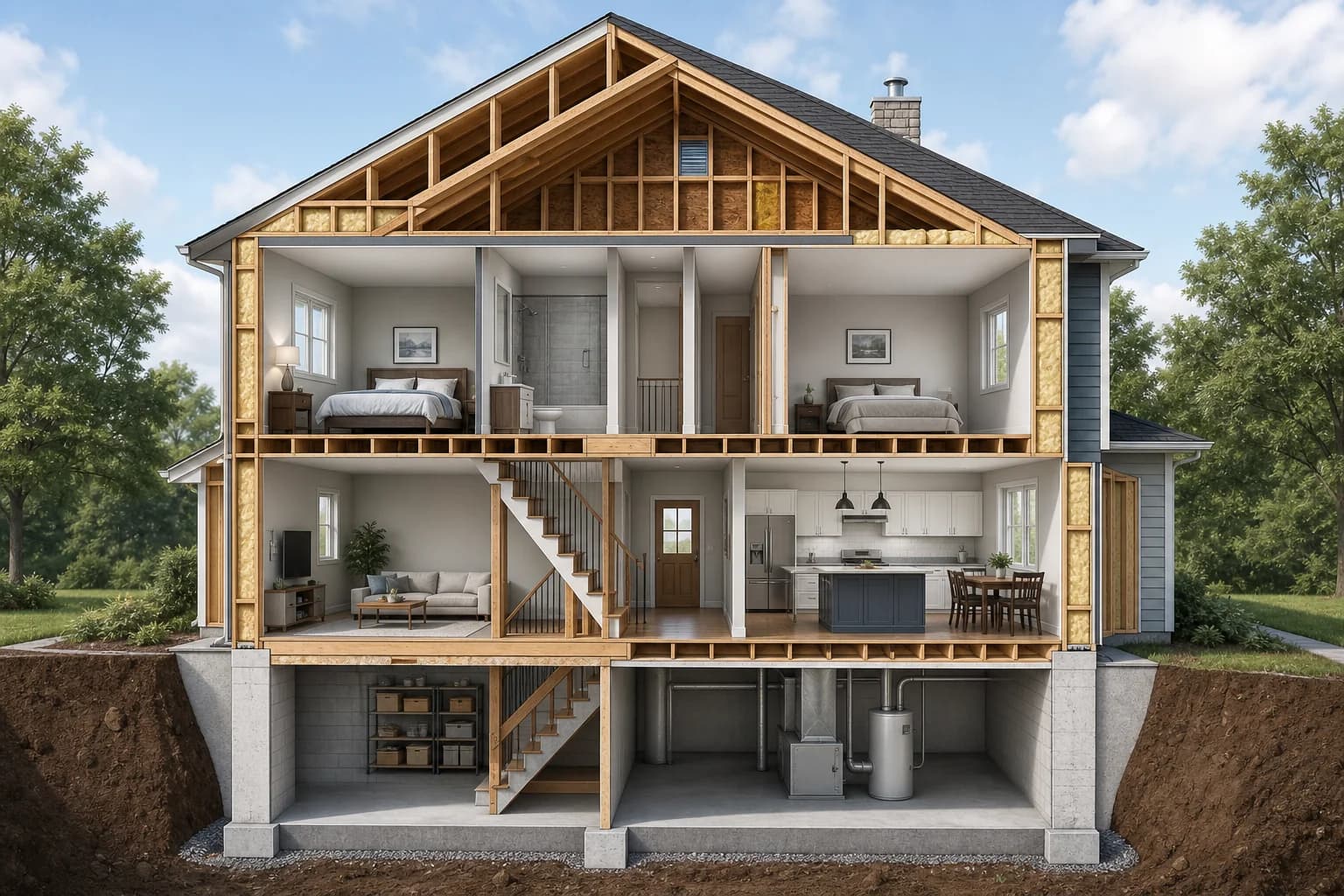
Residential architecture organizes a home into systems that work together. Understanding these layers helps you communicate with your architect and contractor.
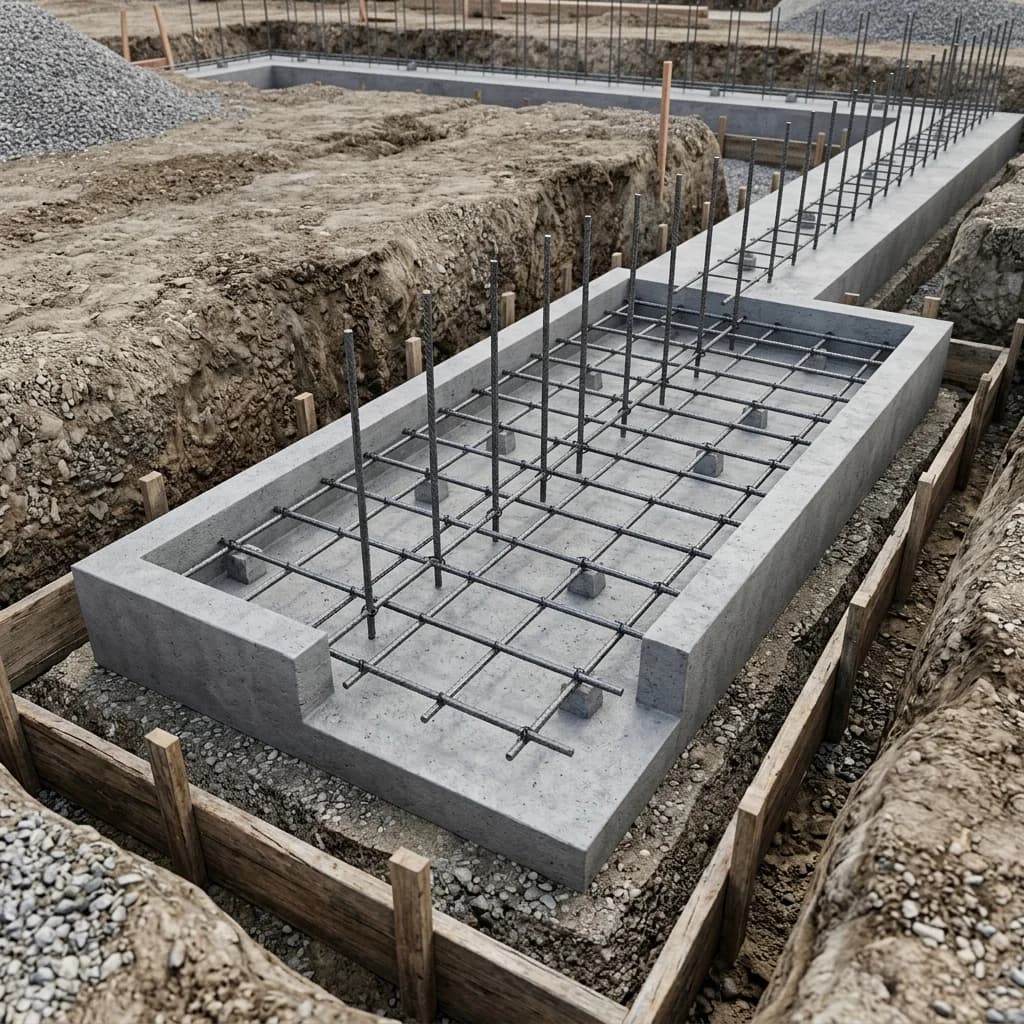
- Foundation: The concrete footing and walls that transfer the building's weight into the ground. Size and depth depend on soil conditions and load. See our Foundation Footing Size Guide and Foundation Calculator for sizing basics.
- Framing: The wood or steel skeleton — floor joists, wall studs, rafters, and trusses — that defines the shape and carries loads. Our Lumber & Wood Calculator helps estimate framing quantities.
- Envelope: Exterior walls, roof, windows, and doors that separate inside from outside. Insulation and air sealing here control energy bills. Use the Attic & Wall Insulation Calculator to plan thermal performance.
- Mechanical systems: HVAC, plumbing, and electrical distribution woven through the framing before walls are closed.
- Interior finishes: Drywall, flooring, cabinetry, trim, and paint that create the lived-in experience.
Architects coordinate all of these systems in the construction documents so they do not conflict — a common mistake in amateur designs is placing a window where a structural beam needs to run, or sizing a room without accounting for ductwork above the ceiling.
Common Residential Architectural Styles
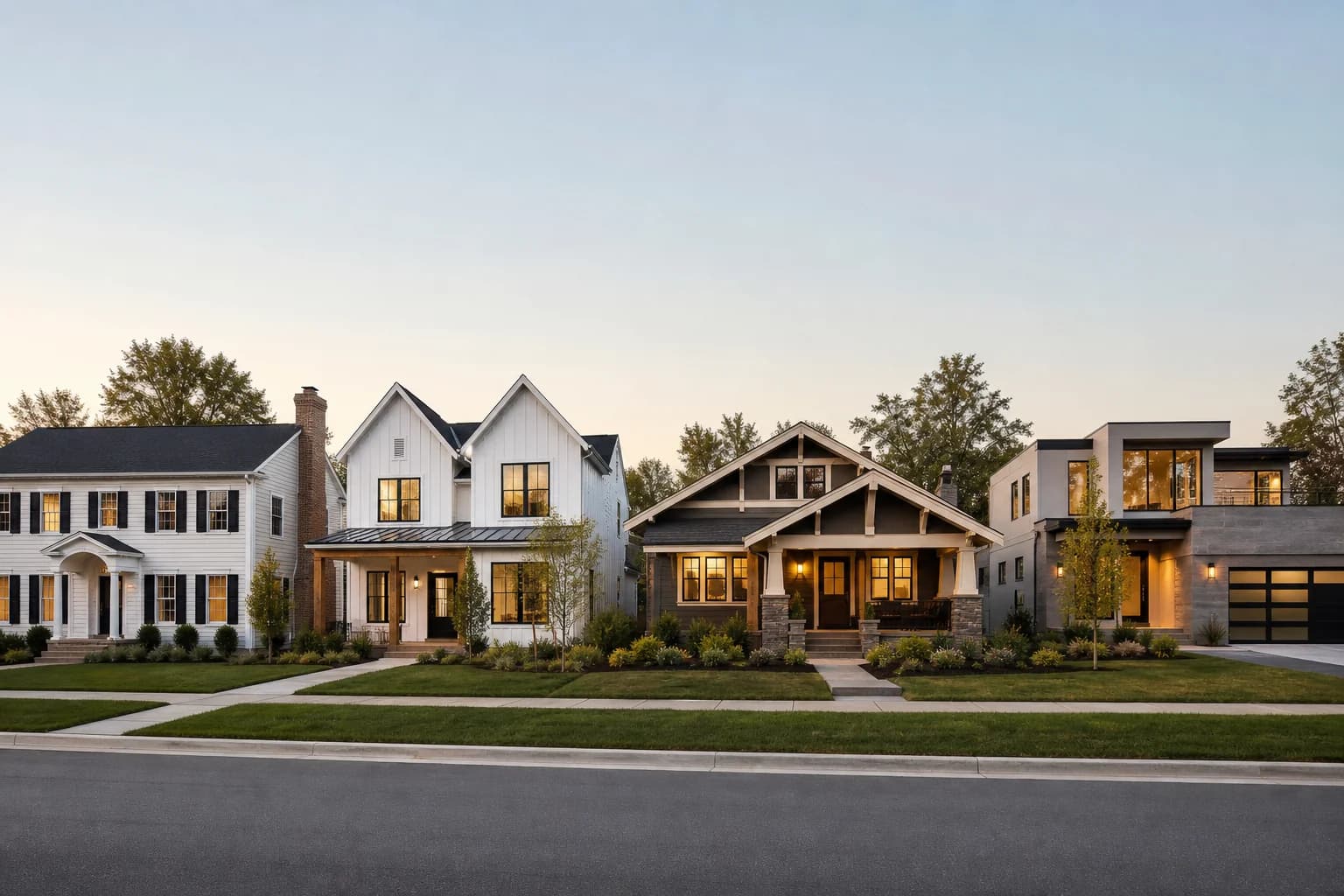
Style is one of the first conversations a residential architect has with a client. Popular styles in the United States include:
- Colonial: Symmetrical facade, centered front door, multi-pane windows, and gabled roof. Classic and formal.
- Craftsman / Bungalow: Low-pitched roof, wide overhanging eaves, exposed rafters, and a front porch with thick columns. Emphasizes natural materials.
- Modern Farmhouse: Board-and-batten siding, metal roof accents, large black windows, and open interior layouts. Currently the most requested custom style.
- Contemporary / Modern: Flat or low-slope roofs, clean lines, large glass panels, and open floor plans. Prioritizes light and indoor-outdoor connection.
- Ranch: Single-story, horizontal footprint, attached garage. Dominant in suburban developments from the 1950s through today.
- Mediterranean: Stucco walls, tile roofs, arched doorways, and courtyard layouts. Common in warm-climate states.
Style affects more than appearance. A Craftsman home with deep roof overhangs sheds rain differently than a Modern flat-roof design. Your architect selects details that match both your taste and your climate.
Key Documents in a Residential Architecture Plan Set
When a residential architect delivers construction documents, you typically receive several drawing types:
- Site plan: Shows the house on the lot, including setbacks, driveway, utilities, and grading.
- Floor plans: Top-down views of each level with room dimensions, door swings, and window locations.
- Elevations: Flat views of each exterior face showing height, materials, and roof pitch.
- Building sections: Cut-through views revealing floor-to-floor heights, foundation depth, and roof structure. Use our Roof Pitch Calculator to understand slope notation on elevation drawings.
- Details: Close-up drawings of critical connections — foundation-to-wall, window flashing, stair railings.
- Schedules: Tables listing every door, window, and finish material with sizes and specifications.
Accurate room dimensions on floor plans feed directly into material estimates. Once you have approved plans, use our Room Volume Calculator and Wall Square Footage Calculator to start quantity takeoffs for insulation, drywall, and paint.
When Do You Need a Residential Architect?
Not every project requires a licensed architect. Here is a practical guide:
| Project Type | Architect Recommended? |
|---|---|
| Custom home on a unique lot | Yes — strongly recommended |
| Major addition (500+ sq ft) | Yes |
| Interior remodel (no structural changes) | Optional — interior designer may suffice |
| Production tract home from builder catalog | No — builder supplies plans |
| Accessory dwelling unit (ADU) | Yes — zoning rules are complex |
| Historic home renovation | Yes — preservation expertise required |
Some states allow a "designer" or "building designer" to stamp residential plans below a certain square footage or number of stories. Rules vary by jurisdiction. Always check your local licensing board before hiring.
How Much Does a Residential Architect Cost?
Architect fees for residential projects typically fall into three structures:
- Percentage of construction cost (8%–15%): Most common for custom homes. A $500,000 build might carry $40,000 to $75,000 in architectural fees.
- Fixed fee: A set price for the full scope, often used for additions and remodels. Ranges from $5,000 for a small addition to $50,000+ for a large custom home.
- Hourly rate ($100–$250/hour): Used for consultations, feasibility studies, or limited scope work like permit drawings for an existing design.
Fees usually cover schematic design through construction documents. Construction administration — site visits during building — is often billed separately at an hourly rate or as an add-on percentage. Factor architectural fees into your total budget alongside materials and labor using our Material Cost Calculator and Labor Cost Estimator.
Sustainability and Energy in Residential Design
Modern residential architecture increasingly integrates energy performance from the earliest design stages. Key strategies include:
- Orientation: Placing living areas on the south side (in the Northern Hemisphere) to capture passive solar heat in winter while using overhangs to block summer sun.
- Building envelope: High R-value insulation, airtight construction, and high-performance windows reduce heating and cooling loads.
- Renewable energy: Roof planes sized and angled for solar panels. Our Solar Panel Calculator helps estimate system size and payback.
- Water efficiency: Low-flow fixtures, rainwater harvesting, and drought-tolerant landscaping integrated into the site plan.
Programs like ENERGY STAR, LEED for Homes, and Passive House certification give architects measurable targets for efficiency. Even if you do not pursue certification, designing with energy in mind lowers utility bills for decades.
Residential Architect vs. Builder vs. Interior Designer
Homeowners often confuse these roles. Here is how they differ:
- Residential architect: Designs the building structure, layout, exterior, and coordinates engineering. Licensed by the state.
- Builder / general contractor: Constructs the home from the architect's plans. Manages subcontractors, schedules, and budgets.
- Interior designer: Selects finishes, furniture, color palettes, and fixtures inside the home. Does not typically design structural elements or stamp permit drawings.
- Structural engineer: Calculates beam sizes, foundation loads, and lateral force resistance. Works under the architect's direction on most residential projects.
On a custom home, the architect and builder often collaborate from schematic design onward so the design stays buildable and on budget. Our article on Nominal vs. Actual Lumber Sizes explains one of the many construction realities architects account for when sizing walls and openings.
Final Thoughts
Residential architecture shapes the places where life happens — morning coffee in the kitchen, homework at the dining table, quiet evenings on the porch. Understanding what residential architecture is and what a residential architect does puts you in a stronger position whether you are building new, renovating, or simply reading your home's blueprints with clearer eyes.
Start with a realistic budget, study your site, and use the planning tools available to you. Our Construction Cost Calculator gives you a high-level budget framework, and our Blueprint Reading Guide helps you translate architectural drawings into actionable measurements.
Frequently Asked Questions
What is the difference between an architect and a home designer?
An architect holds a professional degree, has completed a multi-year internship, and passed a licensing exam. Architects can stamp permit drawings in all states. A home designer (or building designer) may have strong design skills but is not licensed to practice architecture everywhere. Some states allow designers to stamp plans for smaller residential projects. Always verify credentials with your local licensing board.
Do I need an architect to build a house?
You do not need an architect for a standard production home — the builder supplies pre-designed plans. For a custom home, a significant addition, a challenging lot, or any project with complex structural requirements, hiring a residential architect is strongly recommended. Many jurisdictions require stamped architectural drawings for new construction permits.
How much does a residential architect charge?
Residential architect fees typically range from 8% to 15% of total construction cost for a full custom home, or $5,000 to $50,000+ as a fixed fee depending on project size and complexity. Hourly rates for consultations run $100 to $250 per hour. Construction administration during building is usually billed separately.
What is included in a residential architecture plan set?
A complete residential plan set includes a site plan, floor plans for each level, exterior elevations, building sections, construction details, and schedules for doors, windows, and finishes. Structural, mechanical, and electrical drawings may be prepared by separate engineers and included or referenced in the set.
About the Author

Hassan Baloch — An experienced Civil Engineer with more than a decade in building and structural planning. Hassan rigorously verifies the mathematical formulas and code compliance of our estimation tools to guarantee absolute precision. Contact our team for technical inquiries.
Related Guides
Reading Blueprints: How to Extract Accurate Site Measurements
A comprehensive Blueprint Measurement Guide for DIYers. Learn how to find the exact length, depth, and volume requirements for your construction calculators.
Foundation Footing Size Guide for Residential Homes
Understand how to determine the correct size of foundation footing for a residential home. Learn how soil bearing capacity, building load, and frost line depth dictate structural footing dimensions.